

TL;DR
- AI process automation for marketing teams automates repeatable content tasks—ideation, drafting, editing, and distribution—while preserving human review for high-risk outputs.
- Define low-risk vs high-risk boundaries, pick vendors with strong integration points, observability, and rollback paths.
- Run a 60-day pilot tracking throughput, cycle time, quality, error rate, and human review time; use clear decision gates to scale or pause.
- Model total cost including setup, per-transaction, and monitoring; include roles, training, and a RACI before launch.

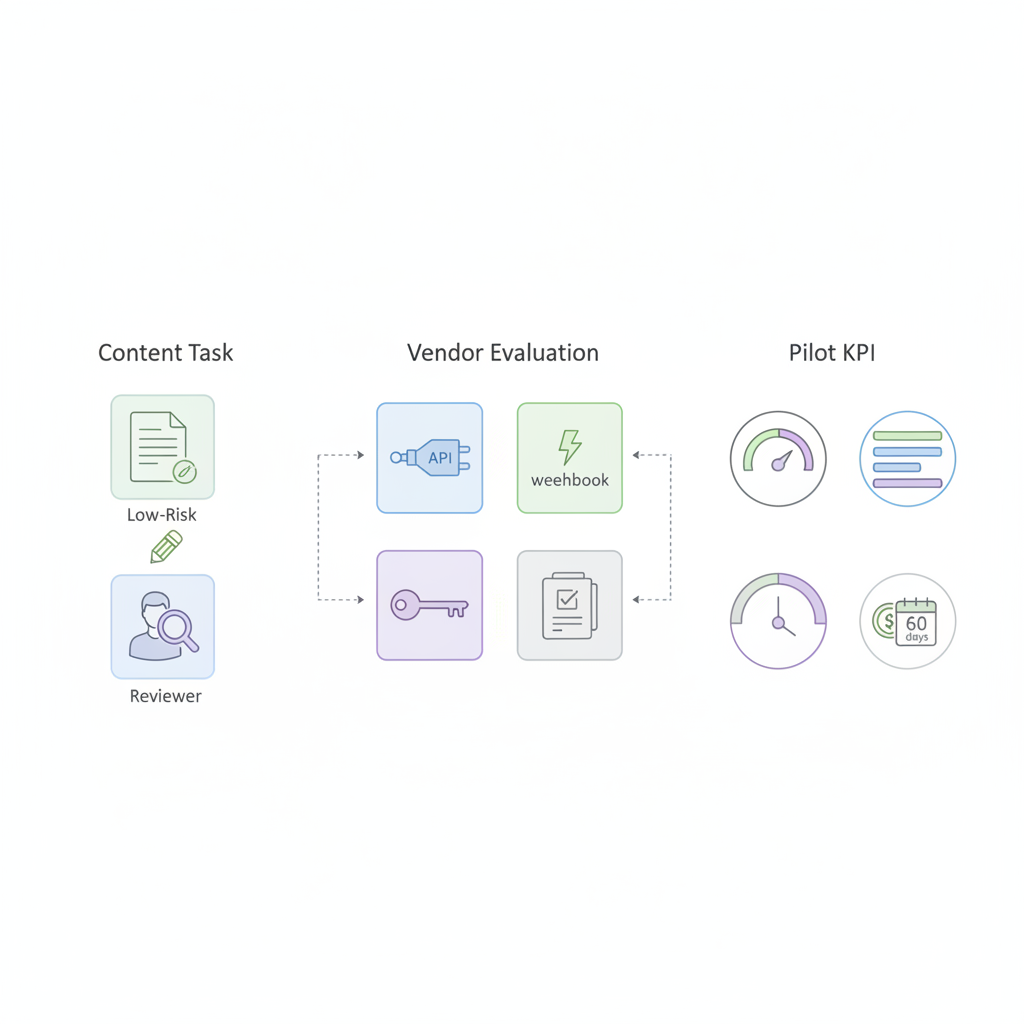
Introduction — what marketing process automation with AI looks like (use cases: content ideation, drafting, editing, distribution)
AI process automation for marketing teams is the use of programmatic workflows and AI models to move content from brief to published state with minimal manual handoffs. A typical pipeline automates idea capture (topic suggestions from search and social data), first-draft generation, SEO-aware editing passes, image or metadata population, and scheduled distribution to CMS and social channels. In North America many teams combine a headless CMS, an editorial workflow tool, and an LLM provider; in EMEA typical stacks emphasize on-prem or EU-hosted APIs to address GDPR. For APAC deployments you should check data residency rules and vendor region support.
"Practical example: you can wire an idea form to an automation that creates a draft, runs a plagiarism and brand-voice check, attaches a recommended hero image, and pushes a scheduled publish task to your CMS. The marketing owner reviews and approves before publishing, leveraging insights from AI tools for marketing to enhance efficiency."
Definition for snippets: "AI process automation is a set of automated workflows that use AI models and programmatic connectors to perform repeatable marketing tasks, reducing manual cycle time while preserving manual review for risky outputs."
When NOT to productionize AI process automation
Who this is not for: do not productionize if your outputs cannot be reliably evaluated, your brand voice is extremely narrow and subjective, you lack a governance process, or the regulatory environment forbids automated handling of personal data. If you cannot measure quality within an editorial workflow or your dataset changes daily such that models will mislead reviewers, pause automation.
- Do not automate customer-facing compliance copy without legal sign-off and auditable logs.
- Do not auto-publish medical, financial, or legal advice without human approval.
- Skip automation when the cost of a single error exceeds the value of throughput (for example, regulated disclosures).
Define the process boundaries to automate (low-risk vs high-risk tasks)
Start by mapping every step in your content lifecycle and marking risk. Low-risk tasks include topic clustering, meta description drafts, image selection suggestions, and scheduling. High-risk tasks include claims about customers, pricing updates, and legal statements. A simple rule of thumb: if a single incorrect token can harm compliance or revenue, flag the step as high risk.
Example mapping: idea generation (low risk), first draft (medium risk), fact assertions (high risk), final publish (high risk). For medium-risk steps, require human-in-the-loop review before the next stage; for high-risk steps, require mandatory legal or product review and an audit trail.
Actionable threshold: treat anything that changes a public-facing contract, price, or SLA as non-automatable without explicit sign-off. Use this boundary to prioritize which ai process automation tools for content you test first—start with low-risk tasks to demonstrate value and reduce resistance.
Vendor evaluation checklist specific to process automation (integration points, security, observability, rollback)
Evaluate vendors against integration, security, observability, and rollback. A practical content automation vendor checklist should include at least these items:
- Integration points: native connectors for your CMS, marketing automation, and analytics; open APIs and webhook support.
- Security and compliance: support for EU data residency, GDPR features, encryption at rest and in transit.
- Observability: requestable logs for each automated job, success/failure metrics, and latency dashboards.
- Rollback and idempotency: the vendor should support safe retries, versioned content drafts, and automated rollback triggers.
Concrete checklist (copyable):
| Item | Must-have | Why it matters |
|---|---|---|
| API + webhooks | Yes | Automate triggers and listen for publish events |
| RBAC & audit logs | Yes | Compliance and traceability for approvals |
| EU data residency | Required for GDPR workflows | Legal compliance |
| Observability dashboard | Yes | Detect silent failures quickly |
An automation is ready to scale when failures are predictable, recoverable, and cheaper than manual processing.
Technical must-haves: APIs, webhooks, RBAC, audit logs
Technical integrations are non-negotiable. Your vendor should offer a documented REST or GraphQL API, webhook events for job lifecycle, role-based access control (RBAC) to restrict who can approve automated publishes, and immutable audit logs for every automated action. Example: configure webhooks to mark a draft as "needs review" and include a payload with model version, prompt, and confidence score.
Target performance thresholds: for editorial automation aim for P95 job latency under 2 seconds for metadata operations and under 5 seconds for draft generation (typical SaaS targets). Ensure the vendor exposes model version identifiers and request IDs for troubleshooting.
Pilot KPIs & success criteria (throughput, cycle time reduction, quality metrics, error rate, human review time)
Define pilot KPIs before you start. Useful metrics include throughput (content pieces processed per week), average cycle time (brief to publish), reduction in human review time, quality score (editor rating), and error rate (post-publish corrections per 1,000 items). Quoted benchmark ranges for pilots: expect 20–50% reduction in cycle time and a human review time reduction of 30–60% for low-risk tasks. Track quality thresholds: target editor acceptance ≥ 85% for first-pass drafts to scale automation.
For regulatory sensitivity, add compliance KPIs: percentage of items with required approvals attached and audit log completeness (target 100%). Use the keyword pilot kpis for ai process automation in your pilot documentation to keep focus on measurable outcomes.
Measure quality and cost together: a 30% cycle-time cut is not a win if error rates double; both metrics must improve or stay flat.
Example KPI dashboard for a 60-day pilot
Build a compact dashboard with daily and cumulative views. Recommended widgets:
- Throughput: items processed per day/week (goal: +30% over baseline)
- Cycle time: median hours from brief to ready-for-review
- Human review time saved: total editor hours saved
- Error rate: corrections after publish per 1,000 items
- Approval compliance: percent with required sign-offs
Example decision rule: if after 60 days throughput increases by ≥25%, cycle time drops ≥25%, and error rate is ≤ baseline +10%, consider scaling. These pilot kpis for ai process automation provide objective gates for go/no-go decisions.
Cost modeling for automation (setup cost, per-transaction cost, maintenance, monitoring)
Model cost as four buckets: initial setup (integration, mapping, rules), variable per-transaction cost (API calls, model tokens, connector operations), ongoing maintenance (rule updates, prompt tuning), and monitoring/observability (dashboards, alerting costs). Example line items: engineer days for integration, monthly API usage, and a monitoring subscription.
Decision rule: compute breakeven as (current manual cost per content piece) × (expected volume) versus (setup amortized + per-transaction × volume + maintenance). Run sensitivity for 20% and 50% higher volume to check scalability. Include a contingency of 10–20% for tuning and retraining in the first 90 days.
Implementation & change management playbook (roles, training, escalation)
Implementation needs clear roles: product owner (defines scope), automation engineer (builds connectors), editor lead (quality sign-off), legal/compliance (approvals), and support (incident handling). Provide role-specific training: editors learn prompt post-editing; engineers learn webhook payloads; legal learns audit logs.
Escalation ladder: automated job fails → automation engineer (T1) → product owner (T2) → compliance/legal for content-blocking issues (T3). Maintain a playbook page describing failure modes and manual override steps so any editor can unpublish or rollback a pushed item quickly.
Sample RACI for pilot and scale
| Activity | Responsible | Accountable | Consulted | Informed |
|---|---|---|---|---|
| Integration build | Automation engineer | Product owner | IT, Security | Editors |
| Pilot monitoring | Editor lead | Product owner | Legal | All stakeholders |
| Scale decision | Product owner | Marketing head | Finance, Legal | Company |
Risk mitigation: privacy, hallucination, brand voice drift
Mitigate privacy risk by anonymizing PII before it enters the model, preferring EU-hosted endpoints for GDPR workflows, and keeping audit logs. To reduce hallucinations, add a verification step for factual claims: call an internal API or attach source citations as part of the automated draft. For brand voice drift, implement a style-checker that enforces tone, vocabulary, and sentence length; require editors to flag voice drift with tags that feed back into prompts.
Concrete control: require a confidence score threshold and automatic hold for any draft with assertions lacking referenced sources. That prevents unvetted claims from reaching production.
Decision gates — when to scale, pause, or stop
Define three gates: scale when KPIs meet or exceed targets and error rates are stable; pause when error rate exceeds threshold or legal incidents occur; stop when cost per piece exceeds manual cost or quality degrades irreversibly. Example thresholds: pause if error rate > baseline +20% for more than 7 days, stop if error rate > baseline +50% or a compliance breach occurs.
Decision process: weekly pilot reviews for first 60 days, then biweekly. Document decisions and retain an audit trail to justify scaling to leadership.
Real-world example: automating blog publishing pipeline (before/after metrics)
Before automation: briefs were emailed, drafts took 48–72 hours, and editors spent 2–3 hours polishing each draft. After automating idea capture, draft generation, SEO passes, and scheduling with a human approval step, teams typically report a single-day reduction in cycle time for low-risk posts and a drop in editor hands-on time by roughly one hour per article. Use these before/after metrics as a sanity check in your own pilot: track time saved, publish frequency, and post-publish edits.
Conclusion & downloadable pilot plan template
"Selecting AI process automation for marketing teams requires careful boundary-setting, a content automation vendor checklist, and clear pilot KPIs for AI process automation. Start with low-risk tasks, run a 60-day pilot with measurable KPIs, and use concrete decision gates to scale. To streamline this process, refer to the AI tool selection playbook for marketing teams, which includes a pilot plan template that lists roles, KPI targets, integration endpoints, and the content automation vendor checklist to speed setup and reduce rework."
FAQ
What is selecting ai tools for content process automation? Selecting ai tools for content process automation is the process of choosing vendors and workflows that use AI to automate repeatable content tasks while preserving human oversight for high-risk outputs.
How does selecting ai tools for content process automation work? It begins with mapping content processes, defining low- and high-risk boundaries, evaluating vendors on integration and observability, running a time-boxed pilot with clear KPIs, and applying decision gates to scale or pause.