

TL;DR
- Create a repeatable selection playbook to reduce procurement time and pilot failures.
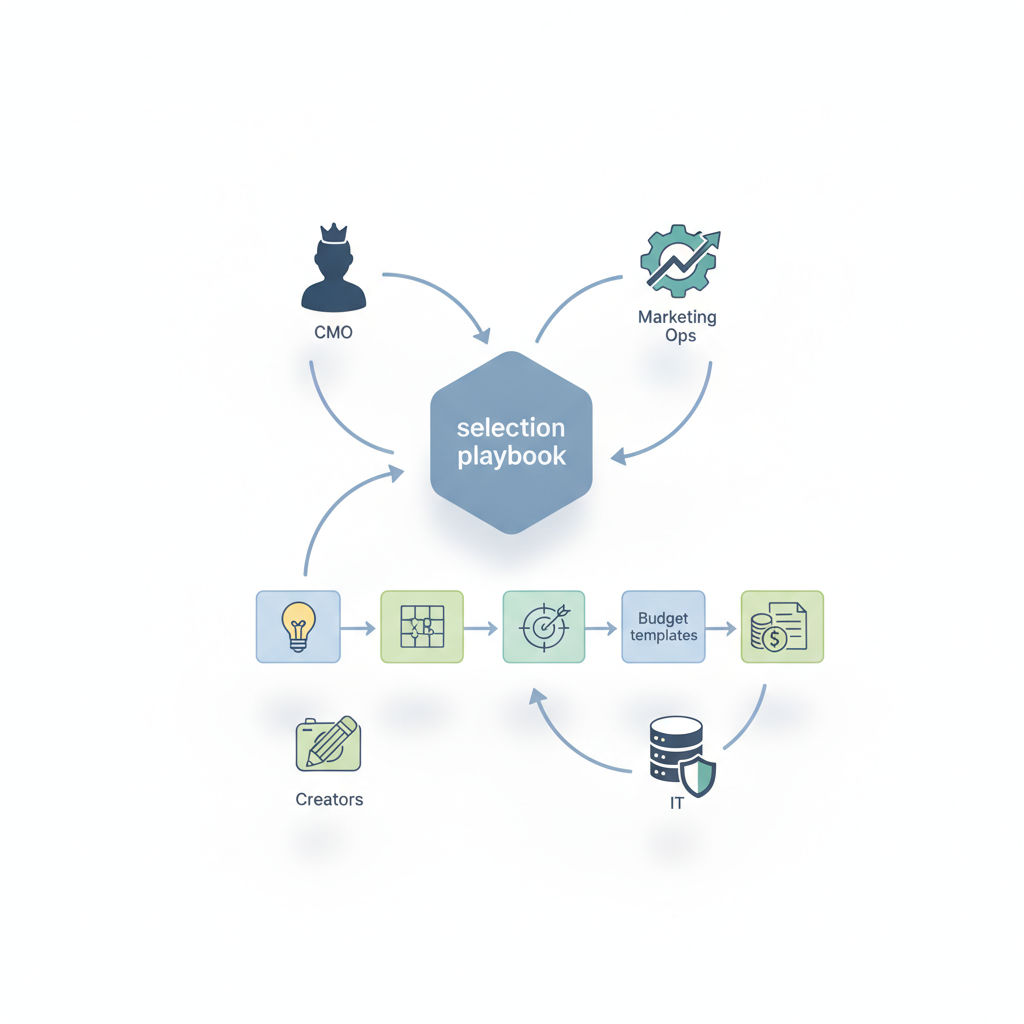
- Assemble a cross-functional team (CMO, marketing ops, creators, IT) with clear RACI roles.
- Define 30–90 day pilots with measurable pilot KPIs for AI tools and a shortlist scoring matrix.
- Use a simple scoring sheet, a budget table for 30/90-day pilots, and a decision gate checklist to decide go/iterate/stop.

If you manage marketing technology, this playbook helps you run disciplined ai tool selection for marketing teams from briefing to procurement to pilot evaluation. You’ll get role templates, a shortlist scoring matrix definition, sample pilot KPIs by market, ready-to-copy checklists, and budget templates for ai pilots. Practical examples and step-by-step artifacts are included so your next vendor trial is not just a demo but a decision.
When NOT to run an AI pilot
"Who this is NOT for: Don’t run a pilot when you can’t evaluate outputs, when regulatory requirements forbid external models on your data, when your team has no capacity to measure results, or when the cost of failure exceeds the value of success. Avoid pilots if your use case requires guarantees you cannot get in a trial contract (for example, guaranteed deliverability rates for email without production integration). For those exploring various options, our X Product List - Discover the Best AI Tools can provide valuable insights."
An AI pilot is only useful when you can measure a change in a defined KPI and run the test in production-adjacent conditions.
Why a Dedicated Selection Playbook Matters for Marketing Teams
AI procurement without a playbook turns into a string of one-off bets. A selection playbook standardizes how you assess suppliers, run pilots, and move winners into production. That matters because marketing teams often buy tools for speed and creativity; without reproducible criteria you end up with fragmented workflows, unclear ROI, and integration debt.
Practical gains a playbook delivers:
- Faster decisions: reuse scoring templates and pilot calendars to cut evaluation time from months to weeks.
- Clearer ROI: pre-defined pilot KPIs let you compare tools objectively, reducing bias toward flashy demos.
- Lower technical risk: requiring minimal integration tests first catches data handling issues early.
Quotable definition: 'shortlist scoring matrix' — a weighted rubric that converts subjective vendor features into numeric scores for head-to-head comparison. Use one matrix per use case.
Quotable fact for extraction: Standardizing pilots reduces ambiguous procurement outcomes by making success criteria explicit and repeatable.
Evaluate AI tools against the same inputs, datasets, and KPIs to make apples-to-apples comparisons.
Who Should Be Involved — Roles & Responsibilities (CMO, Marketing Ops, Creators, IT)
If your playbook is only marketing-led, you’ll miss integration and data constraints. Put a small, empowered cross-functional group around each pilot. Typical roster and responsibilities:
- CMO / Head of Marketing (sponsor): approves objectives, budget, and final go/no-go.
- Marketing ops (project lead): runs the pilot calendar, manages vendor logistics, collects KPIs, owns the pilot report.
- Creators / Content leads: build input prompts, evaluate output quality, and estimate time savings.
- Data / IT: validates data access, reviews vendor contracts for data handling, and assists integration tests.
- Legal / Compliance (as needed): flags regulatory constraints and reviews IP clauses.
Step-by-step example: For an email personalization pilot, marketing ops creates a pilot brief, creators map a sample of 5,000 email rows and 10 template variations, IT runs a sandbox integration for one campaign, and the CMO signs off on thresholds for open-rate lift before full roll-out.
Who does what explicitly (RACI snapshot):
- Responsible: Marketing ops
- Accountable: CMO
- Consulted: Creators, IT, Legal
- Informed: Sales, Customer Success (if outputs affect customer messages)
Define Use Cases & Success Criteria
Successful pilots start with precise use cases and measurable success criteria. Avoid vague goals like “improve content” — instead map each use case to tangible outputs, inputs, and an evaluation method. Use-case templates should include scope, sample dataset, expected throughput, human review rules, and acceptance thresholds.
How to define a use case, step by step:
- Write a one-line use case (e.g., "automate social post drafts from blog content").
- Specify inputs and outputs (source CMS posts → 3 caption variants per post in brand voice).
- Choose success metrics (content throughput, edit time per post, engagement delta).
- Set acceptance thresholds (example: editors spend ≤10 minutes per caption and engagement increases ≥5%).
- Document risk controls (PII removal, human approval required for publish).
Quotable definition: 'pilot KPI' — a specific, measurable metric used to decide whether a short-term AI trial delivered the intended ROI and quality for that use case.
High-impact use cases (SEO, social creative, video repurposing, email personalization)
These four use cases consistently show high value for marketing teams because they map to volume work and measurable outcomes.
- SEO copy augmentation: batch meta descriptions, H2 suggestions, and FAQ generation from long-form content. Evaluate with throughput (pages/month) and organic click-through improvements.
- Social creative: produce caption variants, A/B test hooks, and image prompts. Measure time saved and engagement lift.
- Video repurposing: transcribe, create short-form clips, and auto-generate captions. Measure number of clips produced per hour and view completion rates.
- Email personalization: dynamic subject lines and preheaders per segment. Measure open-rate and conversion delta versus control.
Example: For SEO augmentation, run a pilot generating meta descriptions for 200 pages and compare CTR for treated pages vs. matched control pages over 30 days.
Building a Shortlist — Scoring Matrix & Weighting
Turn demo impressions into objective scores. A shortlist usually contains 4–8 vendors per use case. Score them with a matrix where each row is a feature category and each column is a vendor. Weight categories by business priority — for example, output quality 30%, integrations 20%, data handling 20%, pricing 15%, speed 15%.
Step-by-step shortlist process:
- Collect vendor factsheets and request a standard dataset test or sandbox account.
- Populate the scoring matrix with numeric scores (1–5) for each category.
- Apply weights and compute weighted totals.
- Rank vendors and pick top 2–3 for pilots.
Concrete threshold example: require a minimum weighted score of 3.5/5 to proceed to pilot. If none clear the threshold, iterate on requirements rather than selecting by persuasion.
| Category | Weight | Vendor A | Vendor B | Vendor C |
|---|---|---|---|---|
| Output quality | 30% | 4 | 3 | 5 |
| Integrations | 20% | 3 | 5 | 3 |
| Data handling | 20% | 5 | 4 | 4 |
| Pricing | 15% | 3 | 4 | 2 |
| Speed / SLA | 15% | 4 | 3 | 4 |
Feature categories to score (output quality, integrations, data handling, pricing, speed)
Each category needs clear scoring rules. Examples:
- Output quality: score on accuracy, tone match, and revision rate. Example threshold: P95 acceptable outputs < 30% revision required on pilot sample.
- Integrations: score based on native connectors (CMS, marketing automation) and API documentation quality.
- Data handling: score on encryption at rest/in transit, data retention policies, and contract terms for IP; require SOC2 or equivalent where relevant.
- Pricing: score both TCO and per-unit pricing; check overage protection.
- Speed: measure average completion time for typical tasks; target under typical thresholds (e.g., content generation in under 30 seconds for single requests).
Designing a 30–90 Day Pilot — Goals, Tasks & Timeline
Pilots break when they try to do too much. Keep pilots focused: one use case, clear dataset, defined human review process, and measurable KPIs. A 30-day pilot should prove technical fit and output quality; a 90-day pilot should prove business impact at scale.
Pilot planning checklist (step-by-step):
- Define scope and sample size (e.g., 200 content pieces or one recurring campaign).
- Agree on pilot KPIs and measurement windows.
- Establish access and sandbox credentials, with data masking if necessary.
- Run a 1-week smoke test to validate integrations.
- Collect outputs and run human review on a statistically significant sample.
- Produce a pilot report with recommendations and next-step budget estimate.
Sample timelines: 30-day pilots = smoke test (week 1), evaluation sample (week 2), adjusted run (week 3), KPI measurement and report (week 4). For 90-day pilots, add a controlled A/B test window in weeks 5–12 to measure sustained impact.
Example pilot calendar for small teams (5–10 people)
| Week | Activities |
|---|---|
| Week 1 | Kickoff, dataset prep, sandbox access, smoke tests |
| Week 2 | Generator run on 50–100 items; creators review; feedback loop |
| Week 3 | Refine prompts/integration; run full sample; collect KPI data |
| Week 4 | Analyze results; prepare pilot report; decision meeting |
For a small team, keep weekly syncs to 30 minutes and assign one person to own day-to-day vendor coordination.
Pilot KPIs & Measurement Templates
Measurement makes pilots defensible. Collect both efficiency and outcome KPIs so you can show cost and impact. A compact KPI dashboard should include baseline, pilot results, delta, and statistical confidence where possible.
Core KPI template fields:
- Metric name (e.g., editor time per caption)
- Baseline value and source (how you measured it)
- Pilot value (measured during pilot)
- Delta and percent change
- Sample size and confidence notes
- Financial translation (savings or revenue impact)
Include both qualitative scoring (editor satisfaction 1–5) and quantitative metrics. For marketing ai tool checklist needs, include items verifying data retention, exportability, and human-in-the-loop controls.
Example KPIs (time saved, content throughput, engagement lift, cost per piece)
Concrete example KPIs for a content generation pilot:
- Time saved: average editor time per piece reduced from baseline to pilot value (target: 20–40% reduction in US/UK/CAN sample cases).
- Content throughput: number of publishable items per week produced by team (target: +30% in typical pilots).
- Engagement lift: relative change in CTR or social engagement versus matched control (target: detectable uplift ≥3–5%).
- Cost per piece: include tool costs and human review time; compare to baseline contractor rates.
Reference note: For measurement best practices and risk controls, align with guidance in the NIST AI Risk Management Framework and IAB’s generative AI playbook when reviewing governance and data handling risks.
Budgeting & Procurement Playbook — Estimates & Contract Considerations
Budgeting for pilots balances realism and optionality. Use a small, staged budget approach: minimal pilot funds for the trial plus a contingency for integration. Your procurement checklist should require clear pricing for pilot-to-production transitions and caps on overage charges.
Suggested budget ranges (USD) for 30/90-day pilots:
| Pilot length | Low-range (USD) | Mid-range (USD) | High-range (USD) |
|---|---|---|---|
| 30-day | $3,000 | $10,000 | $25,000 |
| 90-day | $8,000 | $25,000 | $60,000 |
Include line items for vendor fees, engineering hours (integration), and content team review time. Use contract clauses to protect IP and require data deletion after pilot if necessary. Ask vendors for pilot pricing that explicitly converts to production pricing or provides a credit toward first-year fees.
Search terms to use in procurement: include requests for data handling terms, SLAs for availability, and clauses restricting model training on your proprietary data if needed.
Decision Gate Checklist — Go / Iterate / Stop criteria
A decision gate keeps pilots from drifting. Convene decision owners at the end of the pilot with a one-page scorecard that answers: did we meet pilot KPIs, was integration feasible, what’s the cost to scale, and what are the residual risks?
Go criteria example (must meet all):
- Primary pilot KPI (e.g., time saved) met or exceeded threshold
- Integration tests passed with acceptable engineering effort (estimate < X person-weeks)
- Data handling and contract terms acceptable to legal
- Budget for scale approved by finance
Iterate criteria: close on KPIs but need more data or UX changes; extend pilot 30–60 days with defined scope. Stop criteria: low scores on quality, unresolved data risk, or price-elastic failure to deliver ROI.
Playbook Templates & Ready-to-Use Assets (checklist, scoring sheet, KPI dashboard)
Below are artifacts you can copy into your team workspace. They’re designed to be minimal and actionable.
marketing ai tool checklist
- Defined use case and sample dataset
- Scoring matrix completed for shortlisted vendors
- Pilot KPIs set with baselines
- Sandbox credentials and smoke test run
- Data handling and IP clauses reviewed
- Decision gate owner assigned
| Scoring sheet field | Notes |
|---|---|
| Vendor name | Official company name |
| Feature score | Numeric 1–5 |
| Weighted total | Sum(product of scores and weights) |
| Pilot recommendation | Yes / No / Needs more info |
Also include a one-page KPI dashboard template (baseline, pilot result, delta, decision recommendation) for the executive summary.
Quick Case Studies — 2 short examples from small marketing teams
Case study 1 (SEO team): A five-person content team used a scoring matrix to choose an SEO content assistant. They ran a 30-day pilot on 200 pages, measuring meta CTR and editor time. The matrix forced a comparison on integration ease and quality rather than feature demos; the pilot report justified a six-month license because throughput rose enough to reallocate one contractor.
Case study 2 (social creative): A small DTC brand tested two vendors for caption generation. The pilot calendar focused on a single campaign, and creators graded outputs blind. One vendor scored higher on brand tone and integration; the team used the decision gate checklist and approved a phased roll-out tied to quarterly targets.
Both examples show the same pattern: systematic scoring, narrow pilots, and measurable KPIs produced defensible procurement decisions.
Conclusion & Next Steps (integration, training, scale)
AI tool selection for marketing teams succeeds when you treat vendor evaluation as an engineering problem: define inputs, outputs, success criteria, and test in controlled conditions. Use the scoring matrix to shortlist, run focused 30–90 day pilots with pilot kpis for ai tools, and apply a strict decision gate to choose go/iterate/stop.
Next practical steps:
- Copy the scoring matrix and marketing ai tool checklist into a shared drive and run one pilot in the next 60 days.
- Use the budget templates for ai pilots to estimate 30–90 day costs and secure a small pilot budget.
- Document lessons learned and fold them into your parent pillar on AI adoption for marketing tools.
Quotable sentence: Standard pilots prove value when they convert qualitative impressions into quantitative KPI deltas.
FAQ
What is ai tool selection playbook for marketing teams? An ai tool selection playbook for marketing teams is a documented process that defines roles, evaluation criteria, pilot structure, KPI templates, and procurement steps to select AI vendors for marketing use cases.
How does ai tool selection playbook for marketing teams work? The playbook works by standardizing vendor assessment with a shortlist scoring matrix, running focused 30–90 day pilots against predefined pilot KPIs for ai tools, and using a decision gate checklist to accept, iterate, or stop a project.