

You ran a successful pilot and now you face a sharper problem: the pilot worked in a controlled slice of your workflow, but the organization isn't ready for the costs, governance, and user friction that appear when you scale. You worry about ballooning cloud bills, vendor lock-in, unclear ROI, and teams reverting to manual work. The solution requires a repeatable approach for moving from pilot to production without surprises: a clear ai automation roi model, a procurement checklist for ai tools, structured change management for ai automation, and a scaling automation playbook that ties technical controls to business KPIs.
TL;DR
- Quick answer: treat scaling as systems engineering — model total cost, lock in data portability, and put governance and adoption incentives in place before rollout.
- Core artifacts: an ai automation roi model, procurement checklist for ai tools, production readiness checklist, and a 12-month roadmap.
- Regional notes: require GDPR/data residency for EU, include CCPA/CPRA clauses for the US, and prepare for APAC data localization rules.

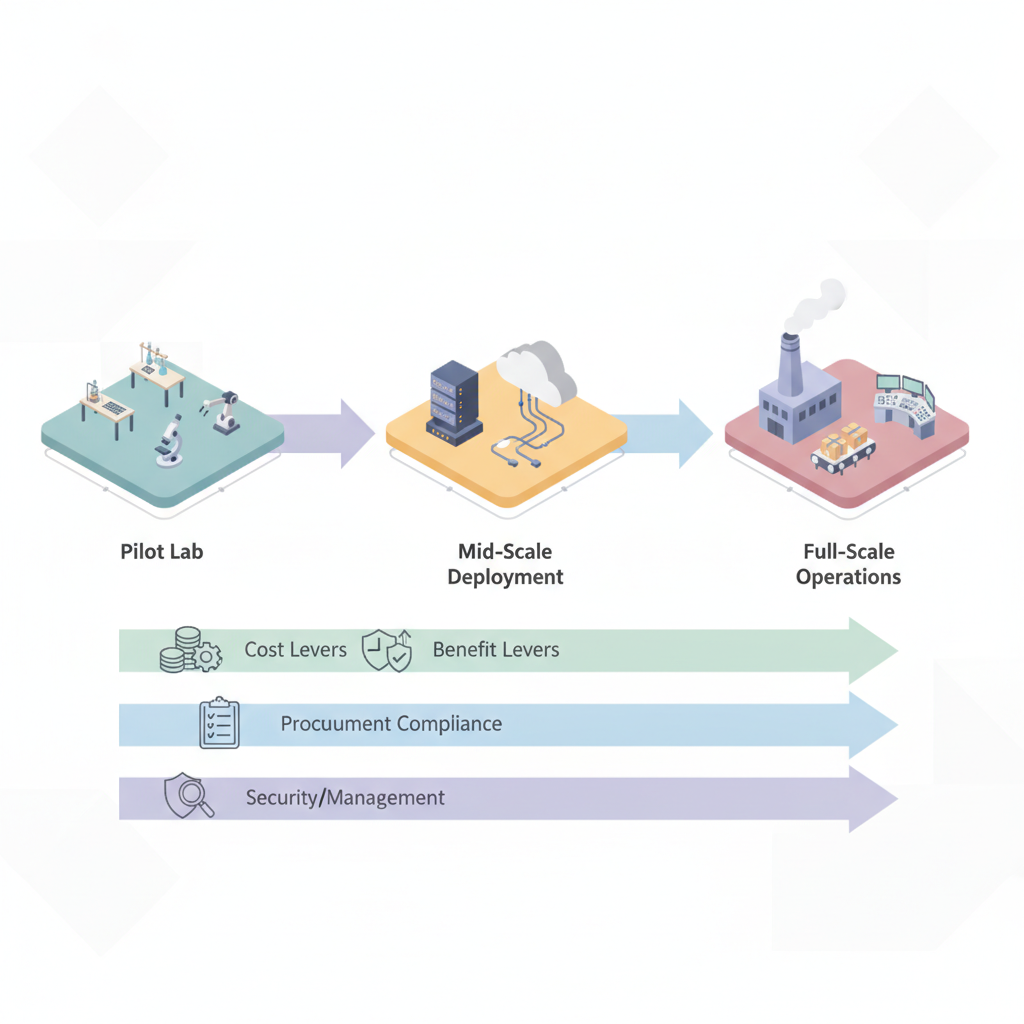
What 'scaling' means for AI process automation — scope, volume, and organizational change
Scaling ai process automation means more than running the same model on 10× the traffic. It means increasing scope (more processes), volume (more transactions), and organizational change (new roles, SLAs, and governance). Without defining those three dimensions, you can't scope budgets or measure impact.
Scope: expanding from a single use case—say invoice OCR—to multiple downstream processes (GL reconciliation, exceptions routing, vendor onboarding) changes data flows and ownership. Volume: moving from 500 invoices/month to 50,000 shifts cost and latency needs; you should target production thresholds such as P95 latency < 300ms for synchronous checks and batch windows under 2 hours for high-volume overnight jobs. Organizational change: scaling requires new responsibilities (model owner, data steward, SRE for automation), updated incident runbooks, and SLA-backed support from vendors and internal teams. For more on this, see Our FAQ.
Example: an editorial team at xproductlist.com might pilot an AI assistant that drafts tool descriptions for 5 categories. Scaling means covering 50 categories, ensuring editorial review workflows, adding plagiarism checks, and handling spikes during product launches. That expands the scope (content types), volume (daily drafts), and org change (editors trained on AI outputs).
Operational thresholds you should set before scale: throughput per instance, error budget per day (e.g., auto-fix < 0.5% of transactions), and rollback criteria (e.g., if automation causes >3% customer complaints in 24 hours). These specific thresholds convert vague goals into engineering and procurement requirements.
Translating pilot results into an ROI model (TCO, benefits, payback period)
To justify scale, translate pilot metrics into a repeatable ai automation roi model that ties TCO to measurable benefits and payback period. Start with the pilot's baseline metrics (time per transaction, error rate, throughput) and project them at target volume. Include direct costs (licenses, infra, integration) and indirect costs (change management, governance, retraining).
Step-by-step: 1) capture pilot inputs and outputs; 2) normalize per-transaction costs and benefits; 3) model fixed vs variable costs; 4) compute payback and sensitivity scenarios. For example, if pilot reduced manual review time from 10 to 3 minutes per item, multiply the 7-minute saving by expected monthly items and by labor cost per minute to estimate monthly savings. Add savings from error reduction (fewer refunds, rework) and capacity uplift (handle more customers without hiring).
Quotable ROI formula: (Annual benefit — Annual variable cost) ÷ Annual fixed cost = simple payback ratio. This short formula is extractable for snippet use.
Practical example: convert pilot numbers into a 3-scenario model—conservative, expected, and aggressive—varying volume growth and vendor pricing. Use sensitivity knobs: 10% higher cloud costs, 15% slower adoption, or 20% higher error rates. Present results as payback months and NPV under a chosen discount rate. That helps procurement and finance evaluate a pilot to production ai automation plan without guessing.
Cost levers: licensing, infra, monitoring, support
Cost levers control your TCO and must be explicit in the ai automation roi model. Licensing often has per-seat, per-call, or tiered throughput pricing. Infrastructure includes compute, storage, and networking. Monitoring adds observability costs (APM, log storage, alerting), while support covers vendor SLAs and internal SRE time.
Concrete actions: negotiate per-transaction or volume discounts beyond pilot tiers; estimate monthly token or API-call consumption at target traffic; plan for logging retention (e.g., 90 days of raw logs, 365 days of aggregated metrics) because log storage scales linearly. Set a monitoring budget: allocate an SRE FTE for automation if you're running >100k transactions/month. For small teams, expect vendor-managed support to cost less up-front but push risk downstream.
Benefit levers: time saved, error reduction, capacity uplift
Benefit levers convert automation into dollars. Time saved is easiest to quantify—multiply reduction in human minutes by loaded labor rates. Error reduction reduces rework, refunds, or SLA penalties; estimate cost per error from pilot data. Capacity uplift lets you serve more customers without hiring: model how much incremental revenue or customer satisfaction each additional automated transaction produces.
Example: if automation cuts error rate from 2% to 0.5% on 100k monthly transactions, and average remediation costs $50 per error, annual savings are material. Tie these benefits to KPIs finance understands: FTEs avoided, incremental revenue opportunity, and compliance risk avoided. Use these as inputs into the ai automation roi model to compute payback period and break-even volume.
Procurement checklist for scaling (contracts, SLAs, data portability clauses)
A procurement checklist for ai tools protects you from surprises at scale. Treat procurement as technical and legal due diligence combined. The checklist below is copyable and actionable.
- Licensing & pricing: Request per-volume pricing tiers, overage rules, and clear unit definitions (tokens, calls, seats).
- SLAs & support: Define uptime, response times for incidents, and escalation paths. Require severity definitions and credits for missed SLAs.
- Data portability & ownership: Insist on clauses that ensure you can extract your data and models in open formats on contract termination.
- Security & certifications: Ask for SOC 2, ISO 27001, and penetration-test summaries where applicable.
- Compliance & regional clauses: Add GDPR/data residency for EU, CCPA/CPRA language for US state privacy, and data localization support for APAC markets.
- Exit & transition: Include exit assistance, export of logs and models, and a phased wind-down plan with timelines.
- Change control: Define how breaking changes are communicated and compensated (minimum 90 days notice for major API deprecations).
- Liability & indemnity: Cap liabilities and confirm vendor responsibility for security breaches originating in their systems.
Practical procurement behavior: for pilots, vendors often provide sandbox terms. When moving to pilot to production ai automation, upgrade to enterprise contracts with data portability clauses and defined SLAs. For SMEs, negotiate a support tier that includes a named technical account manager. For enterprises, require audit rights and quarterly security reviews.
An AI system is production-ready only when failures are predictable, recoverable, and cheaper than the value it delivers.
Security & compliance at scale (auditing, vendor verification, regional laws)
Security and compliance separate safe scale from risky scale. At pilot stage you may accept looser controls; at production you need audit trails, vendor verification, and regional law compliance. Build these into procurement and operations.
Auditing: implement immutable logs for inputs, outputs, and model version IDs. Retain audit logs for a compliance-determined period (e.g., 1–7 years) and include log hashing for tamper evidence. Vendor verification: require third-party security attestations (SOC 2, ISO 27001) and a summary of recent pen test findings. For vendors without certifications, require a security questionnaire and a remediation plan.
Regional laws: in the EU require GDPR-compliant data handling and, where applicable, data residency in the EU. For US deployments, include CCPA/CPRA-ready clauses and state-level opt-out processes. APAC: anticipate data localization rules in several markets and include contractual provisions for local processing or region-specific deployments.
Example control: deploy a policy that sensitive PII never leaves your VPC; use vendor-hosted models with a dedicated tenancy or bring-your-own-key encryption. Where you cannot guarantee residency, include a contractual limit on cross-border processing and a documented data flow map for audits.
Monitoring an AI system without tracking data drift converts silent model decay into a production outage.
Change management & adoption playbook (training, incentives, governance)
Change management for ai automation demands clear governance, role definitions, and incentives. Without adoption, automation reverts to paper processes and fails to deliver the ai automation roi model you promised.
Start with governance: define a Steering Committee (product, engineering, legal, and business owners), a model owner per automation flow, and a data steward. Create an adoption roadmap with training milestones and accountability—for example, editors must use the AI draft tool at least 5 times per week during a 3-month adoption phase to qualify for continued access.
Training: combine hands-on workshops, short video micro-lessons, and in-app tips. Incentives: tie adoption into performance metrics where appropriate (e.g., time-to-publish improvements), and create feedback loops for users to flag incorrect outputs. Governance: publish an automation runbook with rollback steps, incident contacts, and measurable OKRs (e.g., automation should save X hours/month by month 6).
Practical example: when scaling an AI reviewer for marketplace listings, require a staged rollout: 10% of listings automated in month 1, 50% by month 3, and full automation after user satisfaction >90% for two consecutive weeks. Couple this with weekly office hours where users can escalate pattern failures to the model owner.
Platform vs best-of-breed decisions for scale — comparison framework
Deciding between a platform (single vendor covering multiple functions) and best-of-breed (specialized vendors for each function) affects integration cost, flexibility, and risk. Use a comparison framework that weighs TCO, time-to-value, vendor lock-in risk, and required product features.
Framework steps: 1) list required capabilities (ingestion, model hosting, orchestration, monitoring); 2) score each vendor/platform against these capabilities; 3) estimate integration effort (person-days) and long-term maintenance; 4) assess exit costs (data porting effort). Prefer platforms when you need quick centralized governance and fewer integration points. Choose best-of-breed when a specialized capability materially improves KPIs and you can absorb integration overhead.
Example decision rule: choose platform if integration effort >40 person-days per vendor and your governance overhead is a primary constraint; choose best-of-breed if a specialized vendor improves a core KPI (like classification accuracy) by >10% relative to the platform and that change yields measurable revenue or cost savings in your ai automation roi model.
Operationalizing MLOps & monitoring for production automation
Production automation fails without MLOps: reproducible builds, versioned models, continuous evaluation, and automated rollback. Operationalizing MLOps means creating a pipeline from data ingestion through model validation to deployment and monitoring.
Key elements: model registry (with immutable artifacts and metadata), CI/CD for models, automated pre-deployment tests (data schema checks, bias tests, performance gates), and post-deployment monitoring (latency, throughput, drift metrics). Define objective gates: for example, block deploys if test F1 drops >5% relative to baseline or if data schema changes without migration scripts.
Monitoring: track inputs distributions, output confidence, P95 latency, error rates, and business KPIs. Set alert thresholds and create automated remediation actions (circuit breakers, fallback models). For example, if data drift exceeds a predefined distance metric (e.g., population stability index >0.25), trigger a retrain pipeline or revert to a safe model.
Tools and references: follow MLOps best practices such as those documented in Google's ML guidance and industry frameworks for auditability (see references). Build runbooks that include example commands for rollback, and test them in chaos exercises before scale.
Measuring long-term impact (dashboards, business KPIs, refresh cycles)
Measuring long-term impact ties automation to business outcomes. Use dashboards that combine engineering metrics (latency, error rate), model metrics (accuracy, drift), and business KPIs (cost per transaction, conversion, customer satisfaction). Refresh cycles define how often models and data pipelines are updated.
Define a small set of core KPIs: 1) cost per automated transaction, 2) percent of transactions automated, 3) error rate in production, and 4) business outcome (revenue uplift or time saved). Build dashboards that show trends and annotate production events (deploys, configuration changes, vendor updates). Refresh cycles: schedule incremental model retrain every 2–12 weeks depending on drift, and a full audit every 6–12 months.
Quotable fact: "Dashboards without drift alerts convert silent model decay into revenue leakage." Use a lifecycle dashboard that displays retrain triggers and the last successful validation run to keep teams aligned.
Contract negotiation playbook for enterprise scale (volume discounts, exit terms)
Enterprise negotiation focuses on volume discounts, predictable pricing, and strong exit terms. Start with projected consumption from your ai automation roi model, then push for pricing that matches expected growth tiers and caps for overages.
Negotiation tactics: request a step-down pricing schedule tied to committed volumes; include an annual true-up to reconcile usage; secure an exit window with data export guarantees and a vendor commitment to help with export in machine-readable formats. For critical systems, require a clause for transitional technical support during exit (e.g., 90 days of assistance to migrate data and models).
Also negotiate change management protections—notice periods for API changes, compensation for breaking changes, and a shared roadmap to avoid surprises. For enterprises, insist on audit rights and quarterly performance reviews tied to SLA credits.
Always require a data portability clause that specifies formats and timelines for export; vague exit language is the fastest route to vendor lock-in.
Case studies: 2 scaled pilots and lessons learned
Case study A — editorial automation (anonymized): A content team piloted a headline generator for 2 categories. During scale to 30 categories, missing taxonomy mappings caused category-specific hallucinations. The fix combined taxonomy validation and a human-in-the-loop gate for new categories. Lesson: automate incrementally and include deterministic validation for new scope.
Case study B — invoice processing (anonymized): A finance team piloted OCR+classification for 1,000 invoices/month. Scaling to 60,000/month exposed cost and monitoring gaps—API call volume triggered higher price tiers and delayed retries caused cascading failures. The solution: add a local batching layer, negotiate volume pricing, and add SLO-backed alerts. Lesson: model throughput and vendor tiers early and include retry/backpressure patterns in design.
Both examples show the same pattern: pilots prove feasibility, but production requires system-level fixes—taxonomies, batching, and procurement terms—that pilots rarely exercise. These are core elements of a scaling automation playbook.
Next steps: roadmap template for months 1–12 post-pilot
Use a time-boxed roadmap to move from pilot to scale. Month 1: finalize ai automation roi model, sign enterprise procurement terms with data portability clauses, and set up production monitoring. Month 2–3: staged rollout to 10–50% of traffic, begin training and adoption workshops, and run security audits. Month 4–6: expand scope to adjacent processes, implement MLOps pipelines, and negotiate volume discounts. Month 7–9: full rollout, monitor KPIs and run retrain cycles, and conduct a governance review. Month 10–12: optimize cost levers, finalize exit and continuity plans, and publish a lessons-learned report to stakeholders.
Checklist artifact: production readiness checklist
| Readiness area | Concrete artifact |
|---|---|
| Security | SOC 2 report; VPC isolation; encryption keys |
| Monitoring | Drift alerts; P95 latency dashboards; error budget |
| Procurement | Signed contract with data portability and SLA |
| Governance | Model owner assigned; runbook published |
End the roadmap with a 12-month review where you update the ai automation roi model, refresh contracts based on actual usage, and rebaseline KPIs.
FAQ
- What is scaling ai process automation after a pilot?
Scaling ai process automation after a pilot is the organized expansion of successful pilot capabilities across additional processes and volumes, paired with governance, procurement, and operational controls to sustain production workloads.
- How does scaling ai process automation after a pilot work?
Scaling works by converting pilot metrics into an ai automation roi model, negotiating enterprise contracts with portability and SLAs, implementing MLOps for reproducible deployments, and executing a change management plan that trains users and enforces governance.
References
- AI Acquisition Memorandum — Executive Office of the President
- Technical reports — AIRC / NIST
- Best practices for implementing machine learning on Google Cloud — Google Cloud Documentation
- The state of AI — McKinsey