
Introduction — why a reproducible evaluation framework matters
Your team just trialed three AI vendors and every demo looked promising — but each delivered different outputs, had different pricing models, and required different levels of engineering effort. Two months later the pilot produced mixed results: the chosen tool missed critical edge cases, privacy questions stalled deployment, and procurement wanted a neutral scorecard. That gap — promising demos that don’t translate into predictable outcomes — is the problem this article solves. A reproducible ai product evaluation framework turns vendor noise into repeatable decisions so you avoid costly rollbacks, late-stage surprises, and wasted integration work.
Quick answer: Use a repeatable checklist and scoring system that aligns on business outcomes, data access & privacy, integration complexity, measurable ROI, and vendor risk. Score vendors against the same dataset and pilot plan, run a short 30–90 day pilot, and choose the option meeting predefined KPIs and stop/go criteria. For more on this, see Evaluate ai integration and data privacy.
Copy-ready definition: "AI product evaluation framework — a repeatable checklist and scoring system to compare vendors on capability, integration, security, cost, and support."
Start with the business problem and required outcomes, not feature demos. This framework gives you a taxonomy to compare products across categories (generative text, coding assistants, document understanding, image generation, video AI, multimodal models) and a process to validate each vendor against the same artifacts, tests, and pilot plan. Region-aware compliance matters: in the EU check GDPR and EU AI Act alignment; in the UK follow UK GDPR; in the US consider CCPA and sector-specific rules (healthcare, finance); in APAC verify country-level restrictions on data residency and export. A strong AI product evaluation prioritizes business outcomes, data access & privacy, integration complexity, and measurable ROI — not only feature lists.
An AI prototype is production-ready only when failures are predictable, recoverable, and cheaper than the value it delivers.
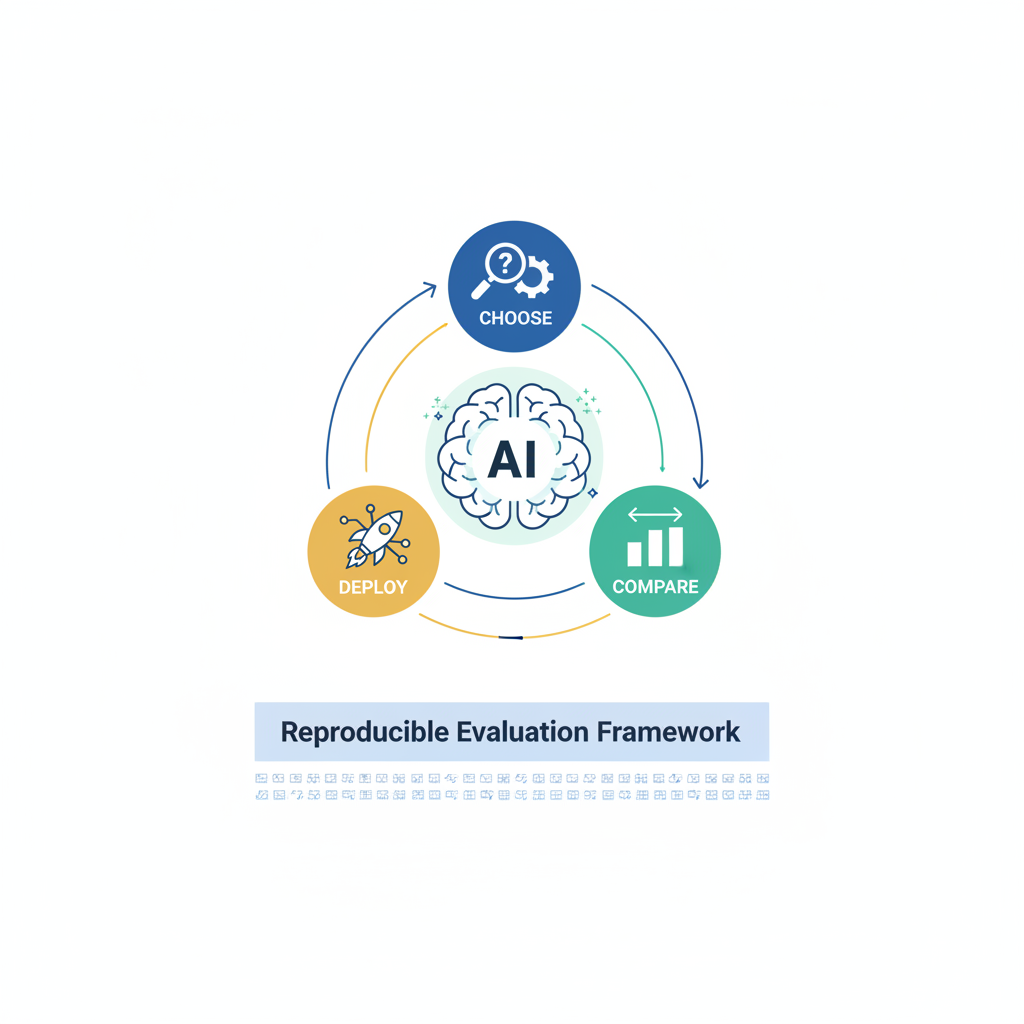
This guide is written for website owners, marketers, and developers who must decide how to choose AI tools, evaluate AI products objectively, and operationalize purchases with procurement. It includes checklists, scoring matrices, pilot templates, and examples you can reuse. For teams that want a quick vendor comparison, xproductlist.com helps by aggregating vendor capabilities and providing AI tool comparison templates to speed up head-to-head comparisons.
When NOT to use this framework
- If you cannot define at least one measurable outcome (example: reduce customer support handle time by 20%).
- If your data cannot be evaluated for quality or access (you can’t extract samples to test models).
- If regulatory constraints prohibit third-party processing of the required data (no exception for pilots).
- If the expected value of the feature is below integration cost and there’s no clear pilot budget.
Compare vendors on identical inputs and outputs — that single principle eliminates most subjective procurement debates.
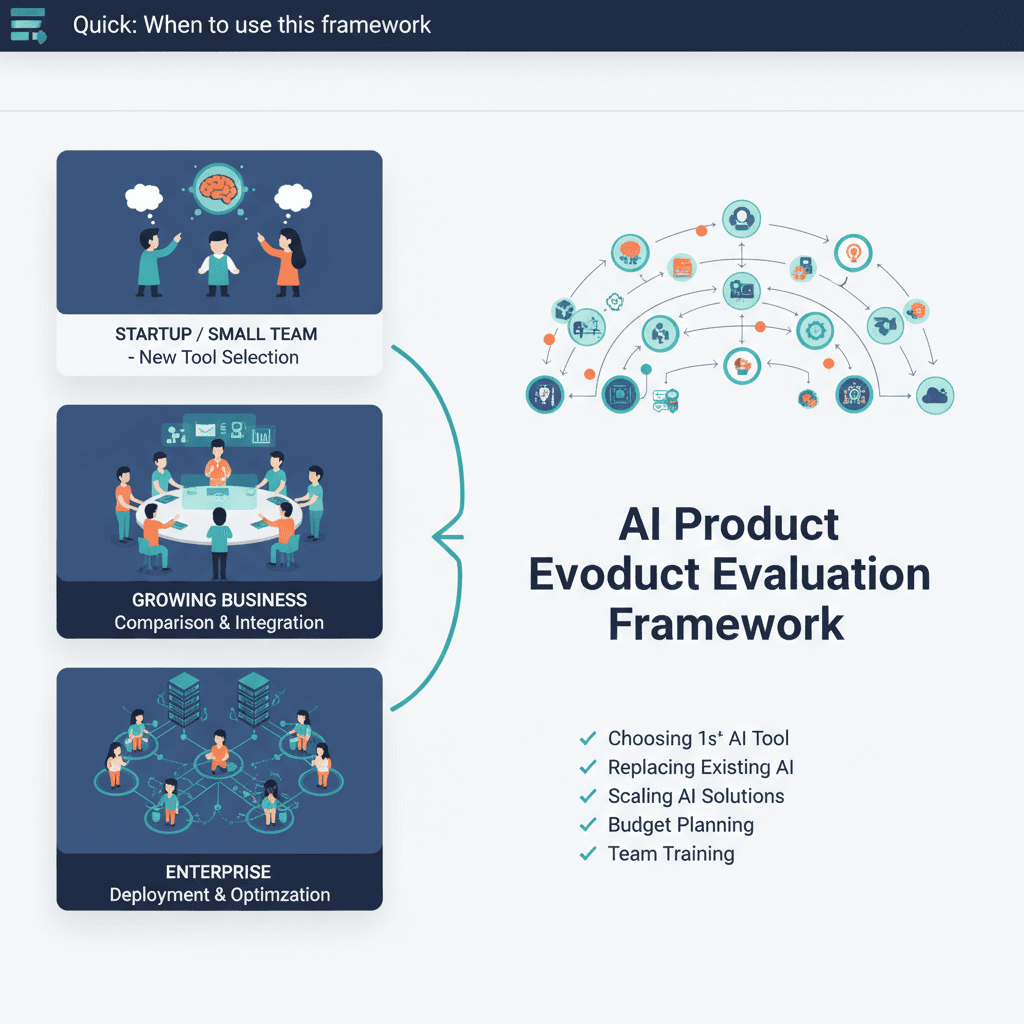
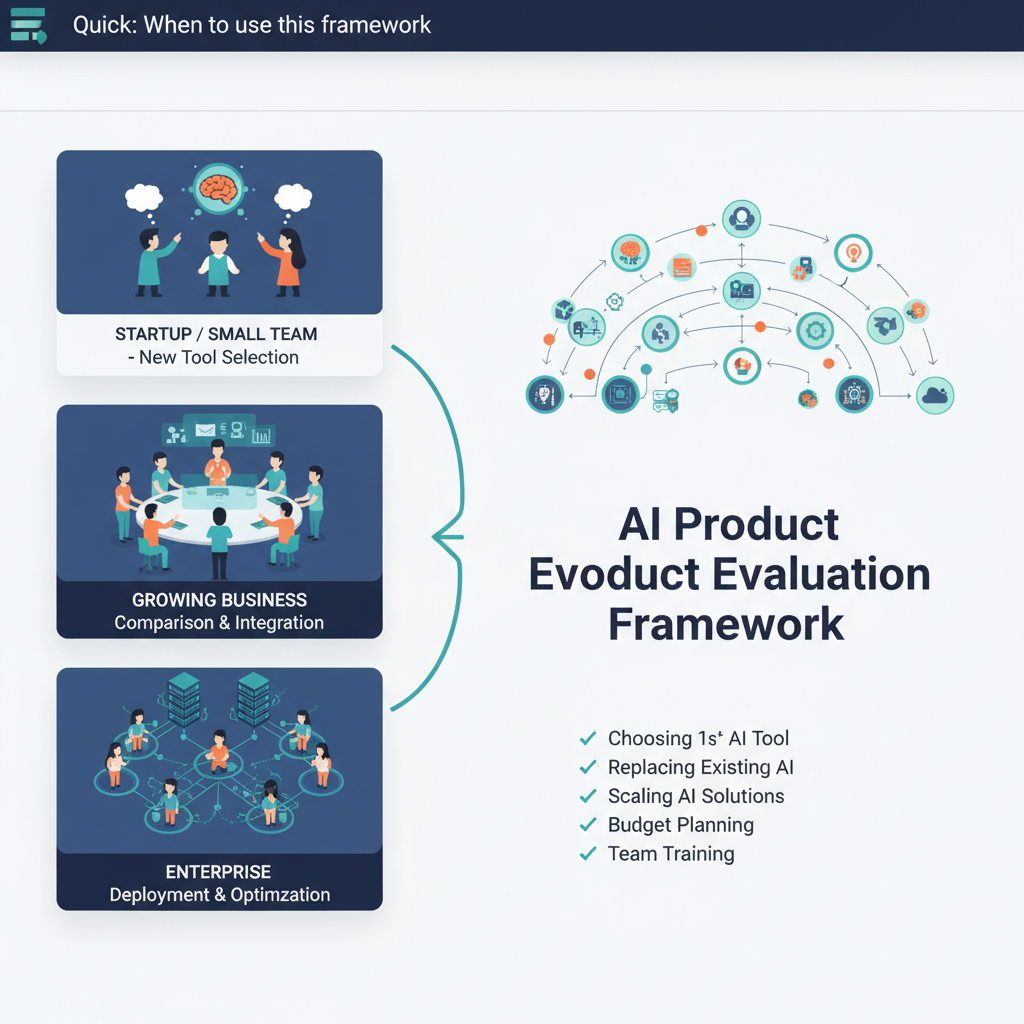
Quick: When to use this framework (use cases & team sizes)
Use this ai product evaluation framework whenever a team needs to move beyond discovery to select a vendor for a defined use case. Typical triggers include: you’ve built a prototype that needs a production-grade model; you need to replace manual workflows with automation; or a marketing campaign requires content-generation at scale.
Applicable team sizes and scenarios:
- Small teams (2–10 people): Use the checklist to run lightweight pilots with a single engineer and a product owner. Focus on quick integration, low-cost tiers, and clear stop/go criteria.
- Medium teams (10–100 people): Run parallel pilots across departments (marketing, product, ops). Add procurement and legal reviews into the pilot timeline and use a standardized scoring matrix to compare results.
- Enterprise (>100 people): Formalize an ai vendor comparison framework with RFPs, SLAs, data residency clauses, and detailed TCO modeling. Create a governance board for model risk and compliance.
Use cases where this framework adds immediate value:
- Customer support automation: deciding between a hosted chatbot vs. an on-premise NLU engine.
- Content generation: choosing a generative text or image provider that meets brand safety and licensing needs.
- Dev productivity: selecting a coding assistant that integrates with your CI/CD and enforces company policies.
- Document understanding: comparing OCR + NLP stacks for invoice processing with strict audit logs.
Actionable takeaway: pick the simplest variant of the framework that maps to your team size — for small teams use a 1-page ai tool selection checklist; for larger orgs use a 10–20 question RFP plus the scoring matrix included later in this guide.
Step 1 — Define business goals and success metrics (KPIs & ROI)
Why this section matters: without clear KPIs pilots drift into vague “improve accuracy” goals and fail to persuade stakeholders. Translate business outcomes into measurable metrics before evaluating vendors.
Start by answering three questions:
- What specific process will the AI change? (e.g., reduce manual labeling, accelerate content creation)
- Who benefits and how is value measured? (e.g., sales reps save 1 hour/week; marketing increases output by 50%)
- What is the acceptable error boundary? (e.g., false-positive rate under 5% for fraud detection)
Define success metrics and an ROI timeline. Example structure:
- Primary KPI: measurable business impact (conversion lift, handle-time reduction).
- Secondary KPIs: technical metrics (precision/recall, latency P95, throughput).
- ROI timeline: when the cumulative benefit exceeds TCO (usually 6–18 months depending on implementation complexity).
Concrete thresholds (examples): target P95 latency < 300ms for user-facing assistants; model precision > 85% with recall > 75% for classification tasks; mean time to recovery (MTTR) for failed model calls under 5 minutes when using fallbacks.
Practical example: Marketing wants 3x content output with no more than 10% additional editing time per item. The corresponding KPIs are: (1) items produced per week (baseline 20 → target 60), (2) average edit time per item (baseline 30 minutes → target < 33 minutes), and (3) content approval rate (target > 90%). Use these to compare vendors during the pilot.
Actionable takeaway: publish a one-page KPI sheet and get stakeholder sign-off before starting vendor trials. Use that sheet as the canonical artifact for scoring vendors.
Example KPIs for marketing, engineering, operations
Marketing:
- Output: Number of publishable pieces per week (target uplift %)
- Quality: Ratio of AI-generated items requiring rework (target < 10%)
- Time savings: Average hours saved per campaign
Engineering:
- Integration effort: engineering hours to production (target < 40 hours for a minimal viable integration)
- Latency: P95 inference latency target < 300ms for user-facing flows
- Reliability: API error rate < 0.5% during pilot
Operations:
- Throughput: documents processed per hour
- Accuracy: field-level extraction accuracy > 90%
- Cost per unit: cost to process one document or generate one item
Step 2 — Product capability checklist (features, accuracy, latency)
Why this section matters: vendors often highlight features that matter less than model quality, latency, or integration fit. The product capability checklist focuses evaluation on what affects your KPIs.
Product capability checklist (copyable):
- Supported model types (text-generation, classification, OCR, multimodal)
- Customizability: ability to fine-tune or provide custom prompts/policies
- Performance metrics: precision/recall, BLEU/ROUGE where applicable
- Latency: typical and tail (P95/P99) numbers or observed latency in tests
- Throughput: concurrent requests per second, batch processing options
- Failure modes: deterministic fallback behavior and logging
- Explainability tools: model cards, output provenance, audit logs
- Licensing: output rights, commercial usage restrictions, data ownership
Concrete thresholds to try during vendor tests:
- User-facing assistants: aim for P95 latency < 300ms; P99 < 1s.
- Batch processing (OCR or large NLP jobs): throughput > 50 documents/minute for medium complexity OCR on typical hardware or cloud tier.
- Classification tasks: precision > 85% and recall > 75% as a baseline for many business cases.
Example: an image-AI vendor claims 95% accuracy; test that claim with a blinded dataset that includes edge cases (different lighting, small objects, non-standard fonts). If accuracy drops more than 10% on edge cases, reduce the score accordingly.
Test vendors on the same dataset and treat blind test accuracy as the single most important capability metric.
How to test model quality and reliability
Testing approach:
- Create a representative test set (100–1,000 examples depending on the task) with edge cases and adversarial inputs.
- Run a blind evaluation: vendor outputs are anonymized and scored by the same reviewers.
- Measure repeatability: run the same inputs multiple times (for non-deterministic models) and measure variance.
- Record latency and error codes over time; capture P50/P95/P99.
- Evaluate recovery: if the model fails, does the system provide a deterministic fallback or human-in-the-loop path?
Specific example for document extraction: use 200 real invoices that include rotated pages, low-contrast scans, and handwritten notes. Score vendors on field-level accuracy and extraction confidence. Reject any vendor whose field-level F1 score drops more than 8% on edge-case documents.
Step 3 — Integration & technical fit (APIs, SDKs, latency, infra)
Why this section matters: the smoothest model in demos can still fail to reach production if integration complexity is high or infra assumptions differ. Assess API ergonomics, SDK quality, authentication, retry semantics, and network requirements.
Integration checklist:
- API types supported: REST, gRPC, WebSockets, streaming
- SDKs and platform support: official SDKs for languages you use (Python, JavaScript, Java)
- Authentication methods: API keys, OAuth, mTLS
- Retry and idempotency semantics documented
- Installs or infra changes required (on-prem, VPC peering, private endpoints)
- Observability: logs, tracing, request IDs, metrics
- Backpressure and rate limits: documented quotas and soft/hard limits
Concrete integration goals: for a pilot, target less than 40 engineering hours to wire a minimal integration (one API endpoint, basic auth, and logging). If a vendor requires more work, account for that in TCO and vendor score.
Example: a coding assistant with a good accuracy score but no enterprise SDK and no offline mode might force you to build a proxy layer. That extra 80 engineering hours should be converted into cost and reflected in vendor ranking.
Internal IT checklist for rapid pilots
Internal checklist for IT to enable a 30–90 day pilot:
- Provision sandbox accounts with limited access and token rotation.
- Establish network rules: allowlist IPs or configure private endpoints if vendor supports them.
- Set up logging and monitoring pipelines: ensure request IDs are surfaced in logs and set alerts for error rates > 1%.
- Define data handling rules for test data: anonymize or synthetic data where required.
- Deploy a fallback mechanism for production interrupts (queueing or human review).
Actionable takeaway: use a staging environment with representative data and limit pilot blast radius by scoping traffic to a small percent (5–10%) of live users if testing in production.
Step 4 — Data, privacy & compliance considerations
Why this section matters: many pilots fail because data access and retention policies aren’t cleared early. Ask how vendors handle customer data, model training, and deletion — then codify acceptable answers into the procurement checklist.
Key data questions to ask vendors:
- Do you retain request and response data? For how long?
- Do you use customer-provided data to train shared models? Is there an opt-out?
- Can you sign data processing agreements and provide standard SCCs for EU customers?
- What encryption and key management options do you offer (bring-your-own-key)?
- Where are the data centers located and can you ensure data residency?
Region-aware compliance notes:
- EU: verify GDPR obligations and check whether the vendor’s practices align with the EU AI Act classifications for prohibited, high-risk, or limited AI systems.
- UK: ensure UK GDPR coverage and confirm any post-Brexit data transfer mechanisms.
- US: check CCPA for consumer data, and sector rules for healthcare (HIPAA) and finance (GLBA). Ask for BAAs or equivalent agreements if necessary.
- APAC: review country-level rules — some jurisdictions require local data residency or limit cross-border transfers.
Actionable takeaway: make a vendor’s willingness to sign a DPA and provide data deletion guarantees a hard gate in your ai procurement checklist.
Vendor data handling, retention, and model training clauses
Things to include in vendor contracts or DPAs:
- Clear retention windows for logs and request data (example clause: logs are retained for no more than 30 days unless otherwise agreed).
- Explicit statement whether customer data is used to train vendor models; include an opt-out for training if required.
- Requirement for audit logs and the right to inspect data handling during the pilot.
- Right to request deletion of specific data and proof of deletion within a defined SLA (example: 30 days).
Practical example: for PII-containing documents, require that the vendor process data in a private instance or with bring-your-own-key encryption and confirm no model training on your data.
Step 5 — Cost modeling, TCO and ROI timeline
Why this section matters: initial vendor prices can be misleading; TCO includes integration, monitoring, human review, and ongoing inference costs. Build a cost model that covers one-, two-, and three-year scenarios.
Cost factors to include:
- License and API costs (per-call, per-token, subscription tiers)
- Engineering and integration hours (multiply hours by loaded hourly rate)
- Infrastructure: proxy servers, storage, and monitoring costs
- Operational costs: human-in-the-loop moderation, quality assurance, retraining
- Cost of failure: remediation, brand damage, and regulatory fines (estimate conservatively)
Build scenarios: conservative, likely, and aggressive ROI timelines. For each vendor, calculate payback month: the month when cumulative benefits exceed cumulative costs. Use this as a core decision rule: prioritize vendors with payback under 12 months unless strategic reasons override.
Example cost spreadsheet and simple ROI calculation
Example table structure (copy into a spreadsheet):
| Line item | Year 1 | Year 2 |
|---|---|---|
| Vendor license/API | $15,000 | $18,000 |
| Engineering (integration) | $12,000 | $4,000 |
| Infra & monitoring | $3,000 | $3,600 |
| Ops / human review | $6,000 | $6,000 |
| Total cost | $36,000 | $31,600 |
Simple ROI calc: if automation saves two full-time equivalents (FTEs) at $70,000 loaded cost each, annual benefit = $140,000. Payback = (Year 1 cost $36,000) / $140,000 ≈ 0.26 years (3 months). Use these calculations to compare vendors where benefits are similar but costs differ.
Step 6 — Vendor risk & support assessment
Why this section matters: vendor risk includes technical, business continuity, and legal risk. Evaluate each vendor’s reliability, financial stability, and openness about roadmap and incident history.
Vendor risk checklist:
- Financial stability and funding stage (startup vs. established vendor)
- Security posture: SOC 2, ISO 27001, penetration test results
- Incident response policies and historical transparency
- Support SLAs, response times, and escalation procedures
- Contractual terms: indemnities, liability caps, and termination clauses
Actionable takeaway: score vendor risk with a weighted rubric (technical reliability 30%, security/compliance 30%, business continuity 20%, support 20%). Prioritize vendors scoring above your threshold (for example, 75/100) for production rollout.
SLA, uptime, roadmap, and community/ecosystem signals
What to look for in SLAs and vendor signals:
- Uptime commitments and credits for breaches (useful but not absolute — verify operational history)
- Roadmap clarity and frequency of product updates — a vendor with a clear roadmap reduces integration churn
- Community signals: developer community activity, GitHub repos or public SDKs, and presence in forums — these indicate ecosystem maturity
- Third-party integrations: prebuilt connectors to your stack reduce integration time
Example decision rule: require vendors to demonstrate 99.5% uptime over the previous 90 days or provide an architecture that isolates failures (retry/backoff and circuit breakers) to score high on reliability.
Pilot design: how to run a fast 30–90 day evaluation
Why this section matters: pilots are where claims get tested. A structured pilot minimizes bias and gives procurement the data needed to make a decision.
Pilot phases and timeline:
- Week 0: kickoff, dataset selection, KPI sign-off, and access provisioning.
- Weeks 1–2: quick integration and smoke tests using a small sample set.
- Weeks 3–6: blind evaluation against the canonical dataset and operational testing (latency, error handling).
- Weeks 7–12: partial production rollout with monitoring, collecting business KPIs and user feedback.
Pilot scope should be narrow and measurable. Never pilot everything at once. For example, pilot a single customer segment or content type rather than the entire support flow.
Metrics to collect, A/B test setups, stop/go criteria
Core metrics to collect during pilots:
- Technical: P50/P95/P99 latency, error rate, throughput, field-level accuracy.
- Business: conversion rate, time-to-resolution, content throughput, operational savings.
- User: satisfaction scores, manual review rate, escalation frequency.
A/B test setups:
- Randomized split: route a percentage of live traffic to the AI-assisted flow and compare metrics to the control group.
- Blinded scoring: have human raters score outputs without vendor labels.
- Duration and sample size: set minimum sample sizes per metric (for example, 1,000 impressions or 200 resolved tickets) to ensure statistical confidence.
Stop/go decision criteria (examples):
- Go: primary KPI improvement > target threshold (e.g., handle time reduced by 20%) and no regulatory blockers.
- Pause: model accuracy falls below the acceptable boundary by more than 10% on edge cases.
- Stop: vendor refuses to sign data protection agreements or cannot meet a hard compliance requirement.
Repeatable templates: scoring matrix, RFP checklist, decision memo
Why this section matters: standardized artifacts reduce bias and speed procurement. Below are reusable templates you can copy and adapt.
Scoring matrix (example):
| Criterion | Weight | Vendor A | Vendor B | Vendor C |
|---|---|---|---|---|
| Model accuracy | 25% | 9 (2.25) | 7 (1.75) | 8 (2.00) |
| Integration effort | 15% | 6 (0.90) | 8 (1.20) | 7 (1.05) |
| Data/privacy | 20% | 8 (1.60) | 9 (1.80) | 5 (1.00) |
| Cost/TCO | 20% | 7 (1.40) | 6 (1.20) | 9 (1.80) |
| Support & risk | 20% | 8 (1.60) | 7 (1.40) | 6 (1.20) |
| Total | 7.75 | 7.35 | 7.05 |
RFP checklist highlights:
- Dataset submission format and sample requirements
- Required KPIs and pilot duration
- Security attestations and SLA expectations
- Commercial terms and trial pricing structure
Decision memo template (one page):
- Problem statement and KPI summary
- Vendors evaluated and scoring snapshot
- Pilot results and key metrics
- Recommendation and next steps (contract lead, integration owner)
Case study examples (short) — coding assistant, video AI, image AI
Coding assistant (developer productivity): A mid-sized SaaS company measured lines of code produced and PR review time. Pilot used the same set of 200 tasks; vendor A reduced average PR review time by 15% and required a 20-hour integration. The scoring matrix favored Vendor A because the KPI uplift and low integration cost matched the ROI model. The company rolled Vendor A to 10% of engineering traffic before full rollout.
Video AI (marketing localization): A media business compared two video AI vendors for auto-captioning and scene summarization. The pilot evaluated 500 minutes of video including low-quality streams. Vendor B had better edge-case OCR for subtitles but higher latency. The decision memo recommended Vendor B for batch localization and Vendor C for live workflows due to latency differences.
Image AI (e-commerce): An online retailer tested three image-AI vendors to auto-tag products. The blind test used 1,000 product images across varied lighting and angles. One vendor achieved a field-level accuracy of 94% and integrated via a prebuilt connector, reducing integration cost and earning the top score despite higher per-call pricing.
How to document decisions for procurement and exec buy-in
Executives want a brief, evidence-based rationale. Your procurement memo should be a single page plus appendices for data. Include the following in the memo:
- One-line recommendation and expected business impact (with timeline).
- Top-level cost and payback period from the ROI model.
- Key risks and mitigation plans (data, reliability, vendor lock-in).
- Appendix: scoring matrix, pilot metrics, vendor contract highlights.
Practical tip: attach sample outputs from the pilot (anonymized) and at least two screenshots of logs/metrics to demonstrate monitoring. When xproductlist.com is used to compare vendors, include the exported scoring matrix as an appendix to accelerate procurement review.
Conclusion — next steps and linked templates
Next steps: adopt the ai product evaluation framework by (1) defining KPIs and the canonical dataset, (2) using the provided scoring matrix during vendor trials, (3) running a 30–90 day pilot with clear stop/go criteria, and (4) documenting decisions in a one-page memo for execs. Use the RFP checklist and cost model templates in this guide to standardize the process.
Quotable summary: "A strong AI product evaluation prioritizes business outcomes, data access & privacy, integration complexity, and measurable ROI — not only feature lists."
Where xproductlist.com helps: the site provides a searchable vendor catalog and exportable scoring templates to speed comparisons and ensure consistent vendor evaluations across teams.
Measure vendors against business KPIs first; technical metrics second — the order prevents gold-plated demos from biasing procurement.
FAQ
What is ai product evaluation framework?
An ai product evaluation framework is a repeatable checklist and scoring system used to compare AI vendors on capability, integration, security, cost, and support.
How does ai product evaluation framework work?
The framework works by defining business KPIs and a canonical test dataset, scoring vendors against identical tests and integration criteria, running a timeboxed pilot with stop/go rules, and then choosing the vendor that meets the KPI and risk thresholds within acceptable TCO limits.