
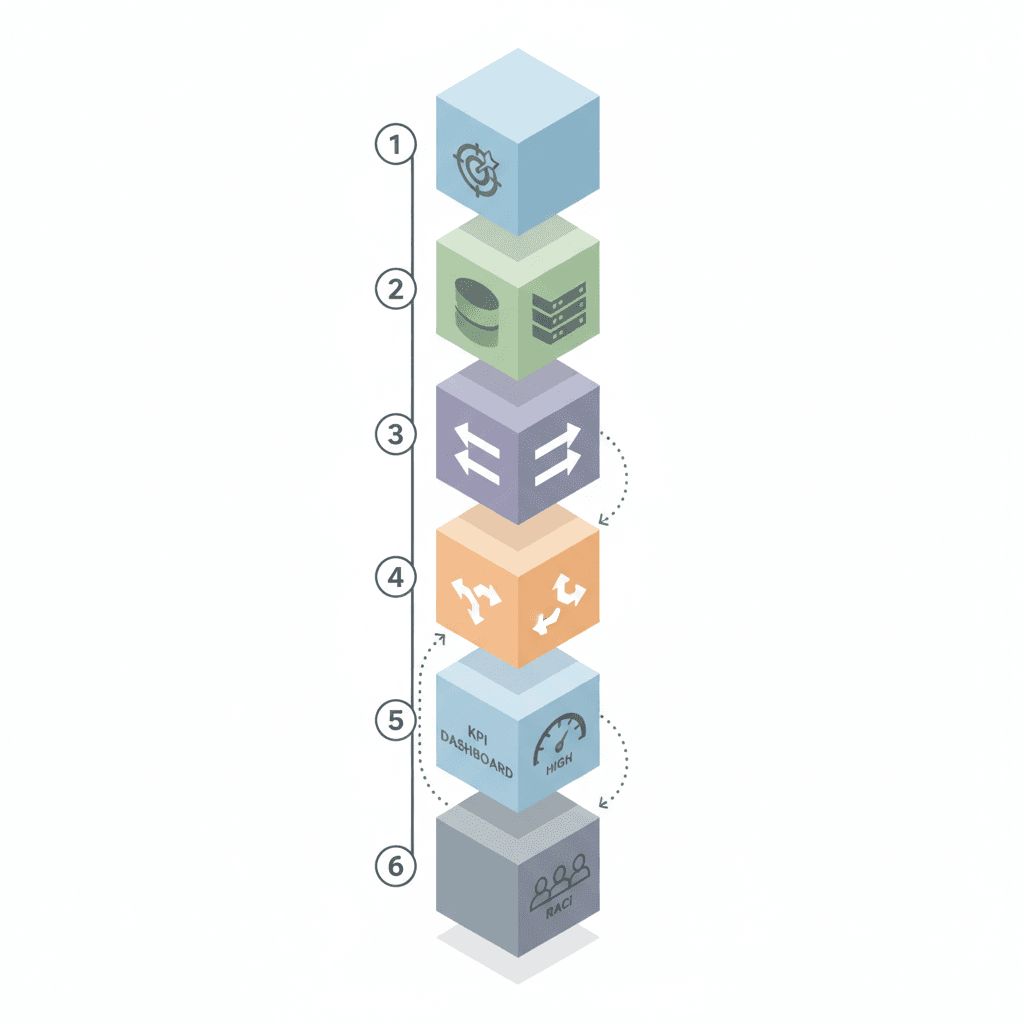
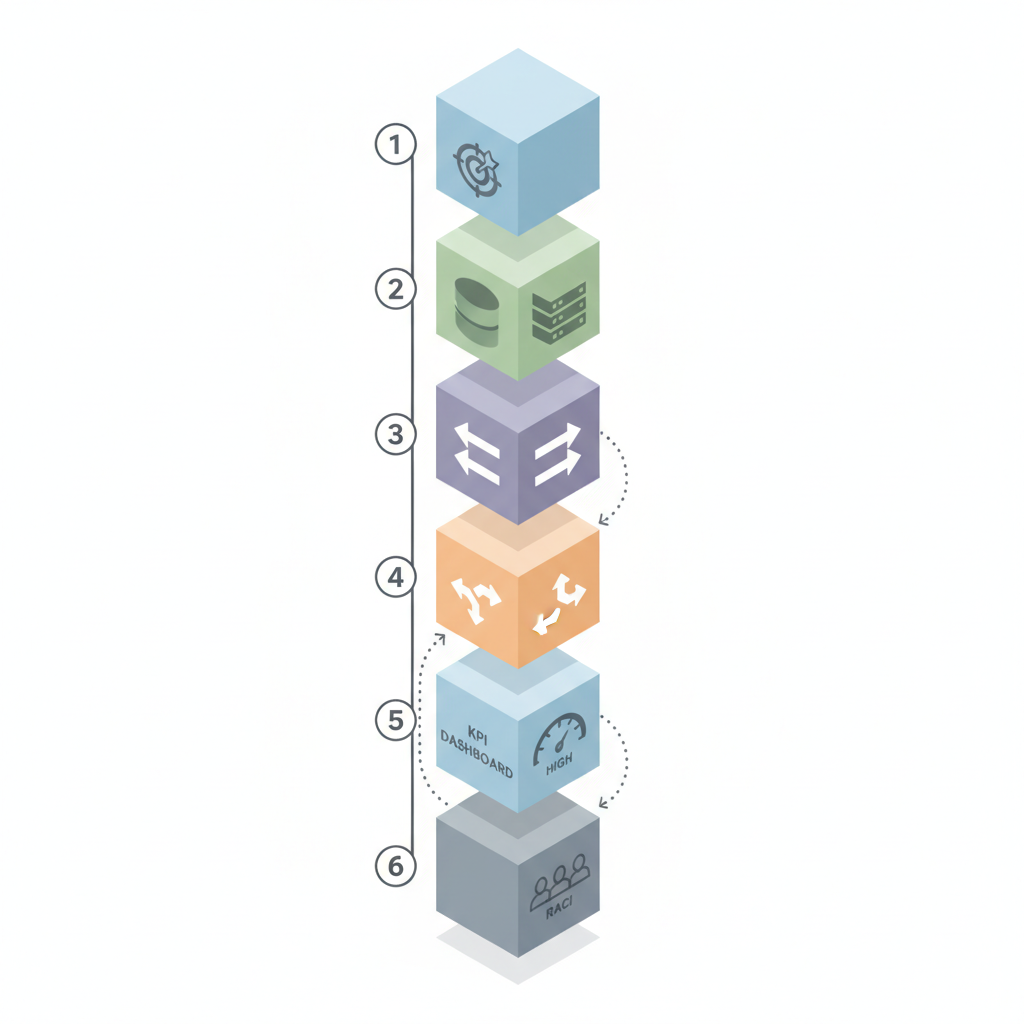
Introduction — goals of a pilot vs PoC
What is an ai pilot framework and how does it differ from a proof of concept or a production rollout?
An ai pilot framework is a structured approach to testing an AI solution in a limited, measurable environment before committing to production. A pilot validates business impact, operational fit, and integration constraints over weeks; a proof of concept (PoC) establishes technical feasibility in a lab-style setting; production is the ongoing, supported deployment for users.
Start with a concise goal: a pilot should answer whether the AI delivers measurable business value under real conditions, not merely whether the model can run. For example, a website owner might run a 60-day pilot that measures whether an AI-driven content recommender increases pageviews per session by 5–15%. Use the pilot to validate assumptions about data availability, latency, and user behavior.
Quotable definition: "A proof of concept tests feasibility; a pilot tests value; production delivers sustained value at scale."
Region notes: in the EU, plan for GDPR-related data access and consent work up front; in the US expect longer procurement and security review cycles for enterprise customers; in APAC, adjust for fragmented data sources and mobile-first usage patterns. These constraints should shape your ai pilot framework from day one.
Why this matters: pilots reduce the risk of expensive, failed rollouts by providing measurable go/no-go evidence in weeks rather than months.
Define clear objectives and success criteria
Define two layers of objectives: business objectives and model objectives. Business objectives answer "why" the pilot exists (revenue, retention, cost savings). Model objectives answer "how" performance will be measured (accuracy, latency, false-positive rate). A clear ai pilot framework ties these together with thresholds that trigger go/no-go decisions.
Practical example: for a content personalization pilot, business objectives could be "increase email sign-up rate by 10%" and "lift average session duration by 8%". Model objectives could be "recommendation precision@10 ≥ 0.20" and "P95 recommendation latency < 300ms". Define both in the project charter and make them visible to stakeholders.
Set time-bound success rules. For a 60-day pilot, require at least two weeks of stable telemetry after initial tuning before evaluating final results. Include minimum sample sizes: aim for at least 10,000 recommendations served or 1,000 unique users exposed to the feature to avoid noisy signals.
Include acceptance criteria for operational readiness: monitoring configured, rollback plan documented, and data storage compliant with local regulations. If you publish results to leadership, present both absolute and relative metrics: absolute (conversion rate reached 3.1%) and relative (uplift +12% vs baseline).
An ai pilot should answer one business question with measurable thresholds, not test every hypothesis at once.

Business metrics vs model metrics
Separate business metrics from model metrics and report both. Business metrics (e.g., conversion rate, average order value, churn reduction) show the downstream impact of the AI on company goals. Model metrics (e.g., precision, recall, F1, latency, token usage) show how the AI is performing technically.
Example mapping: a customer support triage pilot might track time-to-first-response (business metric) and classification accuracy for ticket routing (model metric). If classification accuracy is 85% but time-to-first-response doesn't improve, the pilot failed to deliver business value despite solid model metrics.
Use decision rules: require a minimum model metric (e.g., precision >= 80%) AND a minimum business uplift (e.g., 5–10% improvement) to proceed to production. For productivity automation pilots, typical expected uplift ranges are 10–30% in task throughput or time saved, depending on process complexity; treat these ranges as conditional starting points rather than guarantees.
Quotable fact: "Monitoring an AI system without tracking downstream business metrics converts silent model decay into a production outage."
Select the right use case — impact x complexity matrix
Why this section: choosing the right pilot use case maximizes learning while minimizing cost. Use an impact x complexity matrix to shortlist candidates: high impact/low complexity are ideal pilots; high impact/high complexity may be long-term projects; low impact/low complexity are useful quick wins; low impact/high complexity are poor choices.
Construct the matrix with these axes: expected business impact (revenue, retention, cost) and implementation complexity (data readiness, integration work, compliance). Score each candidate 1–5 on both axes and prioritize those with the highest impact-to-complexity ratio.
Example scenarios for website owners and marketers:
- High impact/low complexity: automated meta-description generation to increase search CTR — needs public content and simple templating.
- High impact/high complexity: personalized homepage for returning users — requires user identity resolution, privacy checks, and A/B infrastructure.
- Low impact/low complexity: auto-tagging legacy blog posts — quick, but limited upside.
Decision rule: pick one medium-to-high impact, low-to-medium complexity use case for a 60-day pilot. Reserve complex systems engineering projects for later phases after a successful pilot.
Data and infrastructure requirements for a 60‑day pilot
Frame: pilots fail when data and infra are treated as afterthoughts. Plan the data pipeline, storage, access controls, and minimal engineering work needed to serve model inputs and capture outputs for measurement.
Data checklist: confirm access to historical data for training/tuning, identify PII and apply masking or anonymization, and confirm retention and deletion policies aligned with GDPR or local laws. For EU pilots, ensure lawful basis for processing and explicit consent flows if using personal data. For APAC pilots, verify cross-border transfer rules for datasets used in cloud model training.
Infrastructure checklist examples:
- Feature store or lightweight data layer to serve model inputs.
- Endpoint or batch job with predictable latency (target P95 < 300ms for interactive features; for batch jobs define SLA in hours).
- Logging and observability: request/response logs, data drift metrics, and model confidence trace.
- Secrets and key management for API keys and model credentials.
Operational example: for a website recommender pilot, implement a lightweight cache for top-100 recommendations to limit latency, and store a copy of served recommendations with user identifiers hashed. Track storage budgets and set retention to 30–90 days depending on experimentation needs.
Experiment design: iterations, baselines, and A/B testing
Frame: experiments must separate signal from noise. Choose a baseline, randomize exposure, and plan for iterative tuning. Your ai experiment design should include experiment length, sample size targets, stratification variables, and an analysis plan before you start.
Baseline: always run the AI-backed feature against a clear baseline—current production behavior or a simple heuristic. For example, compare a neural content scorer to an existing popularity-based ordering. Avoid vague “improved user experience” baselines.
A/B testing setup: randomize users or sessions, maintain consistent allocation for the test period, and guardrail against cross-contamination. Pre-register your primary metric (for example, email sign-ups) and secondary metrics (e.g., bounce rate, latency).
Iteration plan: run rapid cycles—build, measure, learn—every 7–14 days. Use short tuning loops for model hyperparameters, then validate changes with holdout checks. If the AI requires human-in-the-loop review, include a plan for reviewer throughput and measurement of reviewer correction rate.
Quotable design rule: "A single well-powered A/B test beats ten underpowered exploratory runs."
KPIs to track (example dashboard and thresholds)
Frame: pick a small set of KPIs for the dashboard that ties model performance to business outcomes. Include one primary business KPI, two supporting business KPIs, and three model/ops KPIs. Here’s an example dashboard layout and suggested thresholds.
Example dashboard items and thresholds:
- Primary business KPI: conversion rate (target uplift: 5–15% relative to baseline for personalization pilots).
- Supporting business KPI: average session duration (target uplift: 3–10%).
- Model accuracy: precision@k or F1 (threshold depends on task; aim for precision >= 0.75 for user-facing classification).
- Latency: P95 latency < 300ms for interactive features; batch jobs < 1 hour for daily recomputations.
- Error rate: API error rate < 1%.
- Data drift: feature distribution shift alerts triggered when KL divergence > 0.2 vs baseline.
Example KPI table (HTML):
| Metric | Purpose | Example threshold |
|---|---|---|
| Conversion uplift | Primary business impact | +5–15% vs baseline |
| Precision@10 | Model relevance | >= 0.20 for recommenders |
| P95 latency | User experience | < 300ms |
| API error rate | Reliability | < 1% |
Include alerting thresholds and on-call rotation details in the dashboard. For pilots likely to scale, wire basic cost telemetry (API call counts, inference cost) so you can estimate monthly operating cost at production scale.
Monitor both downstream business KPIs and upstream model signals continuously; missing one hides important failure modes.
Team responsibilities and RACI for pilots
Frame: clarity of roles prevents slowdowns. Define a simple RACI for the pilot: Responsible, Accountable, Consulted, Informed. Keep the team small—cross-functional squads move faster.
Suggested RACI for a typical pilot:
- Product lead: Accountable — defines objectives and success criteria; communicates to stakeholders.
- Data scientist / ML engineer: Responsible — builds models, evaluates metrics, and tunes performance.
- Backend engineer: Responsible — implements endpoints, caching, and logging.
- Data engineer: Consulted — provides feature pipelines and data access.
- Privacy/security officer: Consulted — approves data usage and compliance steps.
- QA / Ops: Responsible — sets up monitoring, runbooks, and rollback plans.
- Marketing or growth: Informed/Responsible — coordinates experiment exposure if it impacts user funnels.
Example responsibilities that matter: require the product lead to own the go/no-go decision and the ML engineer to own deployment scripts and reproducible training pipelines. Keep sprint-like 1–2 week checkpoints with written status updates so stakeholders see progress without long meetings.
A practical 60‑day week-by-week plan
Frame: break the 60 days into five phases—setup, baseline, iterate, evaluate, and decision. Each week has concrete deliverables and success signals.
Week-by-week plan (high level):
- Week 1: kickoff, finalize objectives, confirm data access, and set up basic infra and tracking.
- Week 2: run baseline measurements on existing behavior; finalize experiment design and sample size estimates.
- Week 3–4: develop the first model iteration, integrate with a test endpoint, and run limited internal tests.
- Week 5–6: launch controlled A/B test to a small percentage (5–20%) of traffic; monitor early signals and fix issues.
- Week 7–8: expand exposure to full test allocation; run final tuning and collect stable telemetry for two weeks.
- Week 9: analyze results against pre-registered success criteria; prepare decision memo and cost estimate for productionization.
- Week 10: stakeholder review and go/no-go decision; if yes, run production hardening tasks; if no, document learnings and next steps.
Practical tip: reserve 10–20% of engineering time for unplanned fixes during exposure ramps. Keep a living risk register and update it weekly.
Common pitfalls and troubleshooting
Frame: know the common failure modes so you can detect them early. Troubleshoot quickly by checking the most likely causes in order—data, integration, or experiment design.
Common pitfalls and how to address them:
- Poor sample size: Lengthen test or increase allocation; compute power analysis before starting.
- Data leakage: Validate training data windows and ensure no future features leak into model inputs.
- Latency spikes: Add caching and fallbacks; track and enforce P95 latency thresholds.
- User segmentation effects: Check treatment balance and stratify analysis by device, region, or cohort.
- Regulatory blocking: Pause data collection and consult privacy officer; anonymize or stop processing as required.
Troubleshooting workflow: when an alert fires, immediately check (1) data completeness, (2) model input distribution, and (3) endpoint health. Use a runbook with precise reproduction steps and rollback criteria (for example, revert if conversion drops > 5% for two consecutive days).
Handoff checklist for productionization
Frame: a failed handoff causes long delays. Use a checklist to ensure the production team has what they need: reproducible training, monitoring, runbooks, and cost estimates.
Handoff checklist (copyable):
- Project charter with business objectives, model objectives, and final pilot report.
- Training data snapshot and code to reproduce model training exactly.
- Serving endpoints with API specs, auth, and quotas.
- Monitoring & alerting dashboards for business KPIs and model telemetry.
- Rollback plan and runbook with clear owner and on-call rotation.
- Cost estimate for expected traffic at production scale and budget approvals.
- Compliance documentation (data processing agreements, consent flows, DPIAs where required).
- SLA and support plan for incidents and model degradation handling.
Comparison artifact (prototype vs production) as an HTML table:
| Artifact | Prototype | Production |
|---|---|---|
| Training code | Single notebook with sample data | Reproducible pipeline, versioned artifacts |
| Serving | Ad-hoc script or batch job | Scalable endpoint with auth & monitoring |
| Monitoring | Ad-hoc logs | Dashboards, alerts, SLOs |
| Compliance | Manual checks | Documented DPIA and data contracts |
Short case studies and quick wins
Frame: quick wins show value quickly and build momentum. Short case studies help stakeholders imagine practical results.
Case study 1 — recommender quick win: A mid-sized content site implemented an automated meta-description generator as a 30-day pilot. The pilot required minimal infra and delivered a noticeable increase in organic CTRs after re-indexing. The team used the uplift to justify a broader personalization pilot.
Case study 2 — support triage pilot: A small SaaS vendor ran a 60-day pilot that used a classifier to route tickets to the right team. Model precision reached 82% and time-to-first-response dropped 18% for routed tickets. The pilot included a human-in-the-loop safety net during the ramp.
Quick wins checklist for website owners and marketers: prioritize features that reuse existing data and have clear downstream conversion metrics—examples: subject line optimization, content tagging, and automated SEO snippets. You can use xproductlist.com to compare tools for these specific features and shortlist vendors for integration work.
Conclusion and next steps
Running an ai pilot framework means testing business value in a controlled, measurable way before production. Start with clear objectives, pick a high-impact, low-complexity use case, prepare data and infra, design robust experiments, and track both business and model KPIs. Use the 60-day plan above to keep work time-boxed and decisions evidence-driven.
Next steps: select one pilot candidate, run the eight-item checklist during setup, pre-register your metrics and analysis plan, and schedule a stakeholder review at day 45. If the pilot meets pre-registered thresholds, prepare the handoff checklist and production cost estimate.
Quotable next-step: "Run a focused 60-day pilot that answers one business question with measurable thresholds, then decide with data."
FAQ
What is running an ai pilot?
Running an ai pilot is executing a time-boxed, measurable test of an AI feature in a limited production-like environment to validate business value, operational readiness, and compliance before scaling.
How does running an ai pilot work?
Running an ai pilot works by defining business and model objectives, selecting a use case, preparing data and infrastructure, running controlled experiments (often A/B tests), measuring predefined KPIs, and making a go/no-go decision based on evidence.