

TL;DR
- Problem: Teams waste months building AI prototypes that fail in production because data access, clear KPIs, and procurement are left unresolved.
- Quick answer: Use an ai process automation pilot plan that runs in 90 days across Phase 0–3: choose the right process, validate data and privacy, build an integrated workflow, then validate with clear go/no-go gates driven by ai process automation kpis.
- Top KPIs: automation throughput, human handoff rate, error rate, cycle time reduction, cost per transaction, model confidence drift.

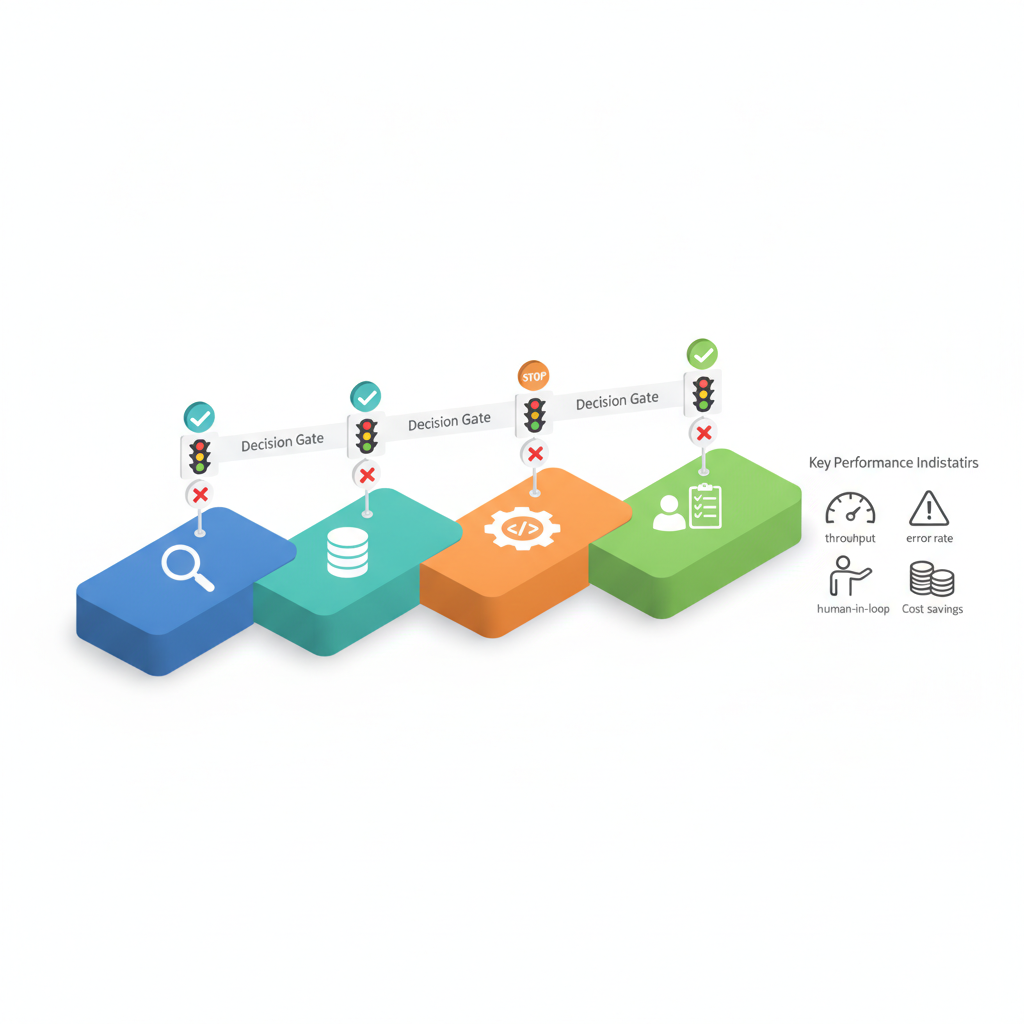
Overview — goals of a 90-day pilot for AI process automation
Without concrete project boundaries, pilots become long-running experiments that never deliver ROI. You probably recognize the pattern: a flashy model demo on a laptop, followed by integration delays, fractured metrics, and procurement headaches. A well-structured ai process automation pilot plan stops that loop by turning a prototype into a measurable, production-ready workflow within 90 days.
The goal of a 90-day pilot is narrow and measurable: prove that an AI-driven process reduces operational cost or cycle time while maintaining acceptable error and compliance levels. For website owners, marketers, and developers, that often means automating a single repeatable task—like content triage, ticket routing, or lead enrichment—and proving clear business outcomes before scaling.
Quick objectives for the 90-day timeline:
- Confirm data access and rights in week 1.
- Deploy an integrated prototype (API + workflow) by week 6.
- Meet decision-gate KPIs for two consecutive weeks by week 12.
Search demand signals matter: GSC signals for the phrase "ai process automation" and related queries show measurable interest (177 and 176 impressions respectively), which is why a short, results-focused pilot helps both product teams and marketing owners capture value faster.
Who this is NOT for
This playbook does not apply if you cannot evaluate outputs, if the data required cannot be accessed or anonymized, or if cost per transaction is higher than the expected user value. Skip productionization when the process is one-off, when legal/regulatory blocking exists (for example, unresolved cross-border data transfers in the EU), or when stakeholders cannot commit to weekly validation cycles.
An AI pilot is production-ready only when failures are predictable, recoverable, and cheaper than the value delivered.
Phase 0: project selection and success criteria (week 0)
Pick one process and one metric. If you try to automate multiple processes at once, integration and measurement multiply the risk. Typical winners for a first ai process automation pilot plan are high-volume, rule-heavy tasks with clear ground truth—example: routing incoming support emails to the correct team.
Step-by-step selection checklist (week 0):
- Map the process end-to-end and identify the handoffs (who touches the work now).
- Estimate volume (transactions per day) and the current cycle time.
- List the business metric you expect to improve (cost per ticket, average handling time, conversion uplift).
- Confirm a single decision owner and a champion from engineering and compliance.
Region-aware items to add in Phase 0:
- EU: run a Data Protection Impact Assessment (DPIA) for personal data processed by models and document lawful basis and minimization steps (store pseudonymized inputs, limit export to third countries).
- US: require vendor security attestations (SOC 2 or equivalent) and include clauses for breach notification and data deletion.
Success criteria (include numeric thresholds where possible):
- Primary KPI target (example): reduce cost per transaction by a customer-specific X% within 12 weeks.
- Quality threshold: maintain error rate below customer-specific Y% for two consecutive weeks.
- Operational SLOs: P95 latency under a target suitable for your app (for typical SaaS, target under 200ms for synchronous APIs; for async tasks allow longer), and human-in-loop (HITL) fallback available under two minutes for urgent queues.
Decision-gate checklist (quotable): "Go to scale if cost/unit reduces by X% AND error rate < Y AND SLOs met for 2 consecutive weeks." Replace X and Y with your targets during kickoff.
Choose processes with clear ground truth and stable data distributions for the fastest path to production.
Phase 1 (weeks 1–4): discovery, data access, and baseline metrics
Phase 1 converts assumptions into facts. Discovery targets three outcomes: instrument baseline metrics, secure data access, and prototype a minimal inference pipeline. If you want to run an ai automation pilot you must prove you can consistently feed data to the model and capture outputs for evaluation.
Week-by-week breakdown:
- Week 1: stakeholder interviews, map data sources, and sign data access agreements. Record current throughput, mean time to resolution, and error counts to create baselines.
- Week 2: extract a sample dataset (representative 2–4 weeks of traffic) and label or produce ground truth for evaluation. If labels don't exist, plan a rapid labeling sprint or use human-in-loop tagging.
- Week 3: build a lightweight ingestion pipeline and anonymization steps; run the model in a non-production namespace and collect outputs.
- Week 4: compute baseline metrics and estimate expected uplift required to pass Phase 3 gates.
Useful baseline metrics to capture now (example values are conditional on your workload): automation throughput, human handoff rate, error rate, cycle time, cost per transaction, and model confidence distribution. These are your control group.
Data collection checklist and rights to use data
This checklist ensures you can legally and practically use data in your pilot.
- Inventory: list data sources, owners, and retention policies for each field used.
- Purpose: document the processing purpose and retention period.
- Minimization: remove or pseudonymize identifiers where possible.
- Consent and legal basis: for EU users include DPIA notes and lawful basis; for US users document contractual authority and vendor attestations.
- Access controls: limit dataset access to the pilot team, use short-lived credentials, and log access.
- Export rules: flag records that cannot leave the country or require additional approvals.
Example: for xproductlist.com, if you plan to automate tagging of AI tool submissions, keep only public listing text plus non-identifying metadata; do not export user-submitted contact details to external model providers without explicit consent and a contract.
Phase 2 (weeks 5–8): build, integrate, and initial model/workflow tests
Phase 2 is engineering-heavy. The goal: wire the model into the live systems in a way that supports observability and safe rollback. Don't treat the model as a black box; wrap it with an API gateway, request validation, and a monitoring shim that records inputs, outputs, latency, and confidence.
Integration milestones:
- Week 5: design interfaces—API schema, retry/backoff strategy, and error codes. Define HITL patterns where human review is required.
- Week 6: deploy the inference endpoint and a feature store or caching layer if needed. Start routing a small percentage (e.g., 5–10%) of live traffic through the pilot in shadow mode.
- Week 7: run a canary with a limited user cohort; collect operational telemetry and labelled outcomes.
- Week 8: tune thresholds and implement automated fallback (e.g., escalate to human queue on low confidence or model error patterns).
Concrete targets to set during Phase 2: P95 latency targets, retry attempts (max 3), and maximum allowed human handoffs per 1,000 processed items. For typical content pipelines, aim for mean latency under 500ms when calling a managed model and implement async processing for slower tasks.
Monitor inputs, outputs, and confidence together—missing any of these converts silent model decay into outages.
Common integration pitfalls and mitigation patterns
Pitfall: data schema drift. Mitigation: validate every incoming payload against a schema and reject or quarantine mismatches. Pitfall: credential sprawl and leaked keys. Mitigation: short-lived tokens and central secret management (rotate keys weekly during the pilot). Pitfall: hard-to-debug failures due to mixed sync/async flows. Mitigation: prefer consistent request patterns; if you must mix, add correlation IDs and end-to-end tracing.
Example failure mode: your model returns high confidence for out-of-scope inputs and downstream systems act on bad data. Fix by introducing a conservative confidence threshold and a quarantine queue processed by humans until retraining occurs.
Phase 3 (weeks 9–12): validation, user acceptance, and go/no-go gates
Phase 3 is about proving business value under production conditions. Run full validation against the baseline and use your pre-agreed decision gate checklist. Validation must include quantitative metrics, qualitative review, and governance checks (security, privacy, legal).
Validation steps:
- Operational validation: measure throughput, latency, error rate, and availability over a two-week window under expected load.
- Quality validation: sample a statistically meaningful set (or use stratified sampling) for human review to compute precision, recall, or other domain metrics.
- Business validation: compare cost per transaction and cycle time to baseline; measure downstream KPIs like conversion or CSAT where applicable.
- Governance checklist: confirm data retention, DPIA sign-off (EU), vendor attestations (US), and a documented rollback plan.
Decision gate example (quotable checklist): "Go to scale if cost/unit reduces by X% AND error rate < Y AND SLOs met for 2 consecutive weeks." Replace X and Y with your organization-specific targets set in Phase 0.
User acceptance typically includes a small stakeholder panel that validates real tickets or workflows. For website owners, this could be the editorial team verifying automated tagging on a 100-item sample. Require unanimous acceptance from the decision owner and at least one engineering sign-off before proceeding.
KPI dashboard template — what to track (throughput, error rate, human-in-loop metrics, cost savings)
The KPI dashboard should be live and accessible to stakeholders. Track these metrics at minimum and visualize trends daily:
- Automation throughput: items processed per hour.
- Human handoff rate: percent of items requiring manual review.
- Error rate: percent of automated decisions reversed or corrected.
- Cycle time reduction: median time-to-completion vs baseline.
- Cost per transaction: total cost divided by items processed.
- Model confidence drift: daily shift in mean confidence for similar inputs.
Include alerting rules: fire an alert if error rate increases by 20% week-over-week, or if model confidence mean drops below a chosen threshold. For AI answer snippet optimization, use concise KPI labels: "Top KPIs: automation throughput, human handoff rate, error rate, cycle time reduction, cost per transaction, model confidence drift." This list is suitable for featured snippets.
Contract and procurement actions during/after pilot
Procurement often kills momentum. Plan contracting steps during the pilot so you can move to a commercial agreement quickly if the pilot succeeds. Start procurement conversations in parallel with Phase 2—do not wait for Phase 3 results.
Contract checklist:
- Service scope: define the inference and support scope, rate limits, and SLAs (availability and latency expectations).
- Security and compliance: require encryption-in-flight and at-rest, breach notification timelines, and data deletion clauses.
- Intellectual property: clarify model ownership, fine-tuning rights, and whether derivatives can be used by the vendor.
- Pricing model: prefer predictable pricing (per-call or per-transaction) with caps during ramp to production. Include a usage-based cap for the first 90 days after go-live.
- Exit terms: ensure you can export your data and model artifacts and that the vendor will assist with on-prem or alternative deployments if needed.
Region notes: EU contracts should include data processing agreements aligned with GDPR; US contracts should request security attestations. Keep procurement lightweight: a short, focused Statement of Work that lists deliverables, timelines, and acceptance criteria is often enough for small pilots.
Scaling playbook — from single process to program (governance, monitoring, continuous improvement)
Once one pilot proves value, convert the single-project playbook into a repeatable program. That requires governance, centralized monitoring, and a continuous improvement loop. Treat the program like an internal product: define owners, funding model, and a roadmap for additional processes.
Scaling components:
- Governance: central AI program office to manage standards, model approvals, and policy exceptions.
- Platformization: provide reusable connectors, a standard schema, and a common KPI dashboard so new pilots can start faster.
- Monitoring: centralized observability for drift, latency, and fairness checks.
- Continuous improvement: a cadence for retraining, test-data refreshes, and quarterly model reviews.
Concrete rollout rule: only onboard new processes that have a documented owner and an expected ROI higher than a threshold you set (for example, justify via projected cost savings over 12 months). For the initial expansion, prioritize processes that share the same data sources or schemas to minimize engineering work.
Case study-style examples and sample daily/weekly tasks for teams
Example scenario: a mid-size content marketplace automates first-pass moderation of new listings.
- Week 1–4: label 3,000 historical listings, build a classifier, and shadow it on live submissions.
- Week 5–8: route flagged items to a small moderation cohort; measure throughput and false positives.
- Week 9–12: validate business KPIs (reduced moderation backlog, faster publishing) and set a decision gate.
Sample daily tasks (pilot ops team):
- Daily: review alert dashboard, inspect low-confidence items, and resolve any blocked message queues.
- Twice weekly: label edge cases and push dataset updates to retraining queue.
- Weekly: stakeholder sync to review KPI trends and decide on tuning priorities.
Sample weekly tasks (engineering):
- Automated tests for schema changes and integration contract tests.
- Monitor system resource consumption and adjust autoscaling or rate limits.
- Run an offline data drift check and escalate significant shifts.
Templates & artifacts to download: pilot plan, KPI dashboard, decision gate checklist
This section provides two reusable artifacts you can copy into your project workspace.
Artifact 1 — Production readiness checklist
- Data access approved and DPIA (if EU) completed.
- Baseline metrics captured and documented.
- API contract, retry/backoff, and correlation IDs implemented.
- Monitoring dashboard live with alerts.
- Rollback and incident runbook documented.
- Contract draft under negotiation with vendor security clauses.
Artifact 2 — Decision matrix (copyable)
| Criterion | Pass threshold | Measured value | Decision |
|---|---|---|---|
| Cost per transaction | Reduce by X% | -- | Go/No-go |
| Error rate | < Y% | -- | Go/No-go |
| SLOs (latency/availability) | P95 < target / uptime >= 99% | -- | Go/No-go |
Use these artifacts as living documents—update thresholds with real results from Phase 3 before approving scaling.
Troubleshooting common pilot failures and recovery plans
Common failure: metrics move in the wrong direction after routing live traffic. Recovery: throttle traffic back to shadow mode, run a quick A/B analysis to separate hypothesis failure from data drift, and label the failure cases for retraining.
Common failure: blocked procurement. Recovery: run a short-term bridge agreement (limited scope, fixed cap) that allows production traffic while finalizing long-term terms, or deploy the model behind a proxy that logs all calls for auditing until terms are signed.
Common failure: compliance red flags during Phase 3 (e.g., unexpected personal data in model inputs). Recovery: pause pipelines that forward data, run a focused DPIA update, and implement field-level redaction with revalidation before resuming.
Recovery playbook (3-step):
- Detect: automated alerts for KPI regressions and drift.
- Contain: move to shadow or reduced traffic and enable human review queue.
- Remediate: label new data, retrain or adjust thresholds, then re-open incrementally.
Conclusion: criteria to decide production rollout and vendor commitments
Decide to roll out when you have three things: sustained KPI improvements, operational SLOs satisfied, and contractual protections in place. Concretely, require two consecutive weeks meeting your decision-gate thresholds and a signed agreement that covers privacy, security, pricing, and exit terms. Mention the primary keyword in the first 100 words and again here: an ai process automation pilot plan that follows this 90-day playbook reduces risk and gives you repeatable steps to move from pilot to scale.
Final quotable sentence: "Move to production only when KPIs are sustained, governance is settled, and recovery plans are tested."
FAQ
What is operationalizing ai process automation?
Operationalizing ai process automation is the practice of turning AI prototypes into repeatable, monitored workflows that meet business KPIs, security requirements, and legal controls.
How does operationalizing ai process automation work?
It works by selecting a single process, securing data and access, integrating models into production-safe pipelines, monitoring key metrics, and using decision gates to approve scaling.
References
- Artificial Intelligence Risk Management Framework: Generative Artificial Intelligence Profile (NIST)
- AI RMF Playbook (NIST playbook)
- European Commission proposal related to AI regulation (EUR-Lex)
- OWASP Top 10 for Large Language Model Apps (OWASP)
- Gen AI governance: 10 tips to level up your AI program (Google Cloud Blog)