

TL;DR
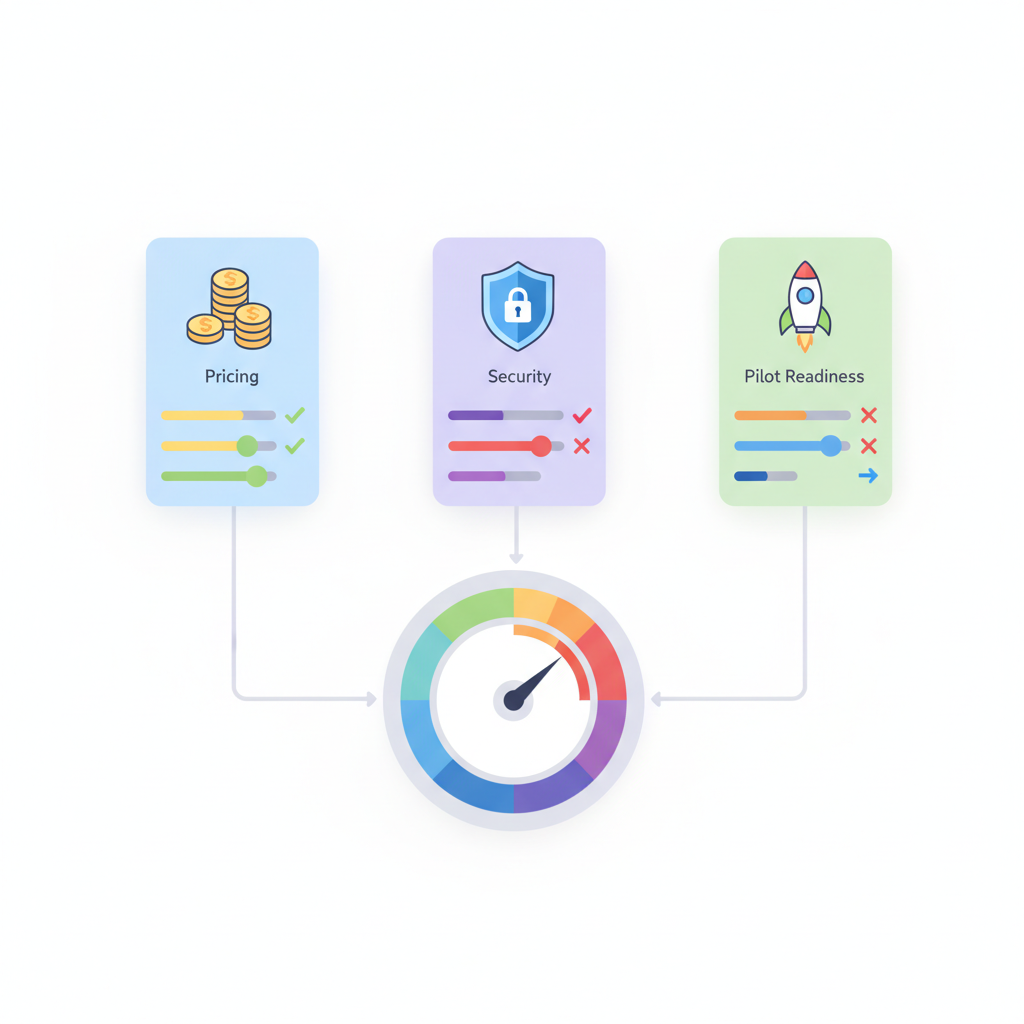
- Use a 10-point vendor score that balances functionality, cost, security, integration, and roadmap.
- Compare ai process automation pricing tiers by modeling cost-per-transaction and subscription scenarios for your workload.
- Request concrete security artifacts (SOC 2, model governance evidence, data flow diagrams) before a pilot.
- Run a short, measurable pilot with acceptance criteria tied to accuracy, latency, and business outcomes.
- Convert scorecard results into a ranked shortlist and an RFP focused on gaps you uncovered.

If you need a repeatable way to evaluate ai process automation vendor options, this guide walks you through an actionable scorecard, pricing comparisons, a security checklist, pilot acceptance criteria, and a copyable vendor-scoring table. Early decisions—incorrect assumptions about pricing tiers, data residency, or observability—are what slow most projects. This guide shows how to spot those problems before you sign a contract and how to shortlist candidates efficiently.
When NOT to evaluate vendors (who this is not for)
Do not run this vendor-evaluation process if any of the following apply:
- Your use case is purely experimental with no repeatable data or evaluation metric — vendor pilots designed for production won’t fit.
- You lack basic data access or ownership rights to produce a training/test split — skip vendor pilots until legal/data access is resolved.
- The expected throughput is near zero and improvements won’t move business KPIs — internal automation or scripts may be cheaper.
- Your procurement timeline is longer than 6 months and you need a fast runway; in that case, choose a short-term contract or a consultancy to bootstrap.
Why vendor evaluation matters for AI process automation projects
Choosing the wrong vendor converts a promising automation pilot into a long procurement cycle, hidden costs, or a data-leak incident. When you evaluate ai process automation vendor options, you verify that the tool matches your process requirements, fits your security posture, and will scale within your operational constraints. That’s different from a quick demo: real evaluation assesses day-to-day reliability, cost under load, and observability.
Example: a marketing operations team chooses a platform based on demo accuracy for invoice parsing. In production, the tool processes PDFs with unusual layouts and third-party stamps. Without checks for data drift and retraining, accuracy falls and manual work returns. A proper vendor evaluation would have required test files representative of the target distribution and an SLA for retraining or fine-tuning.
Regional checklist for procurement teams:
- US buyers: ask for SOC 2 Type II and FedRAMP status where applicable; request evidence of vendor incident response timing.
- EU buyers: require clarity about GDPR roles (data controller vs processor), Standard Contractual Clauses, and whether subprocessors exist.
- APAC buyers: confirm local data residency offerings and any regional certifications required by local regulators.
An automation prototype is production-ready only when failures are predictable, recoverable, and cheaper than the manual process it replaces.
Evaluation framework overview — 10 criteria you must score
To evaluate ai process automation vendor candidates reliably, score each vendor on these ten criteria: functionality, pricing, security, integration, latency, observability, support, customization, compliance, and roadmap. Use a 1–5 scale and weight items according to your priorities. Use this 10-point vendor score: Functionality, Pricing, Security, Integration, Latency, Observability, Support, Customization, Compliance, Roadmap.
Why a scorecard works: it turns subjective impressions from demos into quantitative comparisons. A vendor that looks promising on ease-of-use may underperform on latency or have a pricing tier that balloons under real load. Scorecards expose those tradeoffs.
Practical scoring rules (example): assign 30% total weight to Functionality + Observability for production systems, 25% to Security + Compliance for regulated workloads, 20% to Pricing, 15% to Integration, and 10% to Roadmap/Support. Translate vendor answers into artifacts: feature checklists, benchmark reports, and contract excerpts.
Functional fit & use-case coverage
Score functional fit by mapping vendor capabilities directly to your process steps. Create a one-page use-case matrix with rows for core steps (ingest, normalize, predict/extract, route, human-in-loop, archive) and columns for required accuracy, latency, and throughput. For each vendor, mark whether they provide the capability out of the box, via a connector, or not at all.
Worked example: if your workflow requires 95% field extraction accuracy from scanned receipts and the vendor provides a configurable OCR plus an entity-extraction model, mark as 'configurable.' Ask for evidence: a test run on 200 of your receipts with the vendor’s tool and a confusion matrix. If the vendor refuses to run your data, downgrade functional fit by one score point.
Pricing transparency and pricing-tier traps
Vendors often list base subscription tiers that look affordable until you hit usage, connectors, or higher SLAs. When you evaluate ai process automation vendor pricing, model expected monthly volume and simulate both subscription and cost-per-transaction pricing tiers. Request a cost model: list fixed fees, per-transaction/per-call fees, overage rates, and any charges for connectors, model fine-tuning, or data egress.
Concrete check: build a 12-month cost projection table with conservative, expected, and high-volume scenarios. If a vendor’s tier hides per-connector fees or bills per API call without a clear free threshold, treat that as a pricing-tier trap. Vendors that refuse to provide a sandbox invoice or usage simulation should score lower on transparency.
Data handling, privacy, and compliance
Ask for a data flow diagram showing where data is stored, processed, and transmitted. Verify whether the vendor acts as a processor or controller. Require concrete artifacts: encryption-at-rest specifics, key management approach, and subprocessors list. For EU data, request Standard Contractual Clauses; for US regulated sectors, ask about FedRAMP or industry-specific certifications.
Example threshold: if your company needs data residency in the EU, mark vendors that only offer global multi-region hosting as incompatible. If a vendor offers bring-your-own-key (BYOK) or private cloud deployment, score them higher for sensitive workloads.
Observability, auditability, and model governance
Observability is non-negotiable for production AI. Require logs for inputs, model outputs, decision timestamps, and a way to replay requests. Ask for model lineage and versioning controls. A minimum observability spec: audit logs retained for 90 days, P95 latency snapshots, and a change-log for model updates.
Governance evidence to request: a model risk assessment template, drift-detection hooks, and a documented rollback procedure. Vendors that treat models as opaque services without explainability features or output confidence scores should receive a low governance score.
Monitoring an AI system without tracking data drift converts silent model decay into a production outage.
Integration & extensibility (APIs, connectors)
Score integration on the availability of first-class APIs, SDKs, pre-built connectors (CRM, ERP, storage), and webhook support. Practical test: have your engineering team perform a simple end-to-end integration in a sandbox within 48 hours. If they can authenticate, push a test file, receive parsed output, and trigger a webhook with minimal troubleshooting, the vendor gains points.
Extendability matters: can you add a custom model, run a retraining job, or plug in a third-party model? If a vendor restricts extensibility to higher-priced tiers, record that as an integration cost and penalize the integration score.
Pricing model deep-dive — how to compare cost-per-transaction vs subscription
Comparing ai process automation pricing tiers requires aligning vendor pricing with your workload profile. Start by framing three scenarios: development sandbox, pilot (limited users), and production peak. For each scenario, estimate volume (transactions per day), average payload size, and expected API calls per transaction. Then compare two pricing models:
- Subscription: predictable fixed cost covering a defined seat count, feature set, and usage cap. Good when volume is stable and predictable.
- Cost-per-transaction (pay-as-you-go): variable cost tied to each processed item or API call. Good for bursty volume but risks runaway costs under sustained high throughput.
Example comparison: a subscription at $X/month with a 100k transaction cap vs pay-per-call at $0.Y per transaction. Build a pivot-style table showing the monthly cost breakeven point. If your expected monthly transactions exceed the breakeven point, subscription likely saves money. If uncertain, choose a vendor offering a blended option or volume discounts with a predictable cap.
Watch for hidden costs: per-connector fees, data retention charges, charges for model retraining or label services, and costs for premium SLAs. Ask vendors to provide a sample invoice for your anticipated volume and to sign a pricing annex that caps overage rates during the pilot period.
Tip for negotiators: push to include a usage simulator clause in the contract that triggers a pricing review if monthly volume deviates from projections by more than 30% for two consecutive months.
Security checklist — what to ask and evidence to request
Use this ai automation security checklist when you evaluate vendors. Ask for each artifact and downgrade vendors that decline to produce them.
- Proof of third-party audits: SOC 2 Type II report (or equivalent).
- Encryption details: TLS in transit and AES-256 (or equivalent) at rest; BYOK options if available.
- Data flow diagrams and subprocessors list with termination notice clauses.
- Vulnerability management program and patch cadence; request recent pentest summaries.
- Incident response plan and mean time to detect/respond commitments.
- Access control policies: role-based access, multi-factor authentication, and SSO support.
- Model-specific controls: data minimization for training, test datasets handling, and model explainability features.
Ask for evidence, not just claims. Request redacted SOC 2 reports, a sample data flow diagram, and an overview of the vendor’s identity provider (IdP) integrations. For high-security workloads, require a security addendum that clarifies subprocessors, incident notification windows, and the right to audit.
Regulatory pointers: reference the NIST AI Risk Management Framework when you evaluate governance controls, and use the OWASP vendor evaluation guide for practical vendor questions on application security.
Pilot-readiness checklist — sample acceptance criteria for vendor pilots
A pilot should run for a fixed window (typically 4–8 weeks) and measure against clear acceptance criteria. Define success metrics before the pilot starts and share them with the vendor. Sample acceptance criteria:
- Functional: end-to-end workflow runs on 90% of test items without manual intervention.
- Accuracy: target F1 or extraction accuracy meets the pre-agreed threshold (for example, above your baseline by X points — define the number in your pilot script).
- Latency: P95 latency for processing should be below your threshold (for typical SaaS workflows, target under 200ms for API-only steps; for document-heavy pipelines, target under 2s per document parse where possible).
- Reliability: error rate below 0.5% and demonstrable retry behavior for transient failures.
- Security: pilot environment follows encryption and access controls; no sensitive data is sent to third-party test endpoints without agreement.
- Operational: monitoring and alerting produce actionable signals in your observability stack during the pilot.
Sample pilot plan steps:
- Week 0: align on test dataset and success criteria; sign a pilot agreement with scoped pricing.
- Week 1: vendor deploys sandbox; run connectivity tests and an initial batch of 50 items.
- Week 2–3: run full test dataset, collect metrics, evaluate false positives/negatives, and iterate on configuration.
- Week 4: finalize acceptance report and decision to scale, renegotiate, or terminate.
Hands-on vendor scoring template (downloadable or copyable table)
Use the table below as a copyable vendor evaluation scorecard. Score vendors 1–5 for each criterion and multiply by the weight column to get a final weighted score. Replace weights to reflect your priorities.
| Criterion | Weight | Vendor A score (1-5) | Vendor B score (1-5) | Notes / Evidence |
|---|---|---|---|---|
| Functionality | 0.20 | Feature matrix, demo outputs, test run | ||
| Pricing (model + transparency) | 0.15 | Sample invoice, pricing annex | ||
| Security & compliance | 0.15 | SOC 2, data flow diagram | ||
| Integration & APIs | 0.12 | Sandbox integration test | ||
| Observability & governance | 0.12 | Logs, drift detection, lineage | ||
| Latency & reliability | 0.10 | P95, error rates | ||
| Support & SLA | 0.08 | Response times, escalation | ||
| Customization & roadmap | 0.08 | Custom model options, roadmap clarity |
How to use it: fill in scores, compute weighted totals, then rank vendors by total. For transparency, keep the notes column populated with the exact artifact name (e.g., “SOC2 report dated 2024-10, redacted”). This table is your vendor evaluation scorecard ai automation artifact to include in procurement files.
Quick comparisons: sample vendor maturity tiers and recommended buyer profiles
Vendors fall into three practical maturity tiers. Use these profiles to align buyer expectations and how to shortlist candidates:
| Maturity tier | Typical buyer profile | Strengths | Risks |
|---|---|---|---|
| Startup / early-stage | Small teams, rapid experimentation | Fast iteration, flexible pricing | Limited SLAs, fewer compliance artifacts |
| Growth-stage | Mid-market, scaling operations | Balance of features and reliability | Feature gaps for enterprise integrations |
| Enterprise / established | Regulated industries, high volume | Certifications, robust SLAs, governance | Higher cost, slower feature delivery |
How to shortlist: use a two-stage approach. First, filter by hard constraints (data residency, required connectors, must-have features). Second, apply the scorecard to the remainder and run pilots with your top 2–3 vendors. That’s how to shortlist ai automation tools without wasting time on mismatches.
How to run vendor pilots efficiently and avoid common procurement delays
Procurement delays often stem from misaligned expectations. Prevent delays by creating a short, tightly scoped pilot agreement that includes a pricing cap, data handling terms, and a clear acceptance matrix. Keep legal requirements scoped to the pilot environment; avoid negotiating enterprise-wide indemnities during the pilot stage.
Operational steps to speed the pilot:
- Pre-authorize data sets, define redaction rules, and agree on what counts as sensitive.
- Provide a representative dataset and a small cross-functional evaluation team (product, security, and engineering).
- Use time-boxed sprints: weekly checkpoints and a mid-pilot readout to catch integration issues early.
- Include a pricing annex that freezes pilot pricing and caps overages to avoid billing disputes later.
Common procurement traps: lengthy legal negotiations over model IP (which you can defer), unclear SLAs for model drift remediation, and undefined exit paths for data deletion. Address these in the pilot contract and require the vendor to demonstrate deletion in the sandbox to validate the process.
Next steps: converting scorecard results into an RFP or shortlist
Once you have scorecard results, convert them into a short RFP focused on gaps. The RFP should summarize pilot outcomes, list missing capabilities, and ask targeted questions that surfaced during scoring. Use vendor ranks to create a three-tier shortlist: primary candidate, secondary backup, and a negotiation target.
Actionable checklist to convert scores into procurement items:
- Include the weighted score and attach the evidence column from the vendor evaluation scorecard ai automation table.
- List the non-negotiable contract terms discovered during the pilot (data residency, audit rights, pricing caps).
- Request a pilot extension clause that preserves pilot pricing if you choose to scale.
- Set an internal decision deadline and circle back with finance for TCO sign-off.
Quotable summary: Use the vendor scorecard to turn subjective demos into objective purchasing decisions.
FAQ
What does it mean to evaluate ai process automation vendors?
To evaluate ai process automation vendors means to assess potential providers against a structured set of technical, security, operational, and commercial criteria so you can rank, pilot, and select the best fit for your use case.
How do you evaluate ai process automation vendors?
Evaluate vendors by running a weighted scorecard across functionality, pricing, security, integration, observability, and roadmap; validating claims with sandbox tests and artifacts; and executing a short pilot with measurable acceptance criteria.
References
- AI Risk Management Framework — National Institute of Standards and Technology (NIST)
- Vendor evaluation guide — OWASP
- Announcing the AI Controls Matrix & ISO 42001 Mapping — Cloud Security Alliance
- Gartner Magic Quadrant for Robotic Process Automation — Gartner
- Types of Power Automate licenses — Microsoft Learn