
Quick answer — what is TCO for AI process automation?
You may be staring at vendor quotes, token bills, and integration estimates and wondering whether an AI automation project will quietly eat your margins. The hard part is that costs split across many teams and months: a one-off build, then recurring model, compute, and maintenance spend. The solution is to measure everything under a single framework so you can compare pilots and vendor proposals consistently.
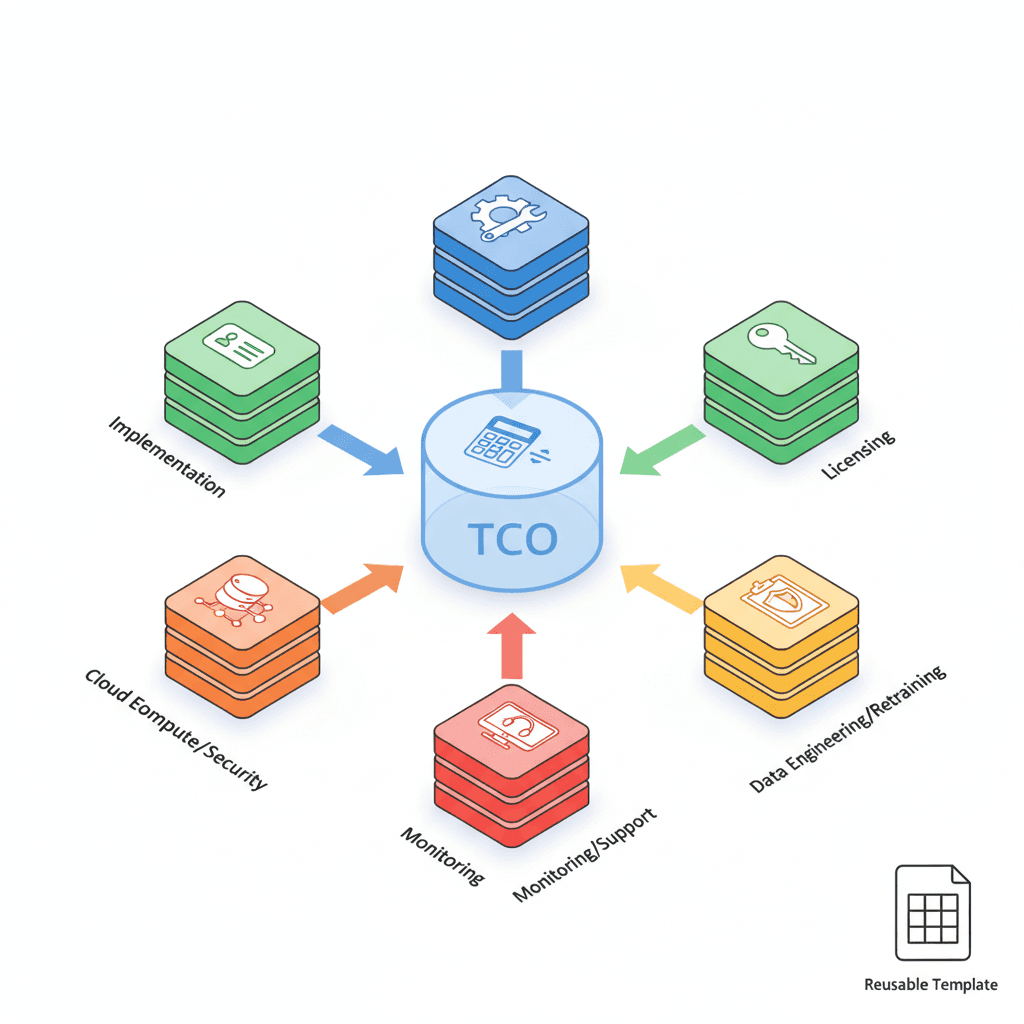
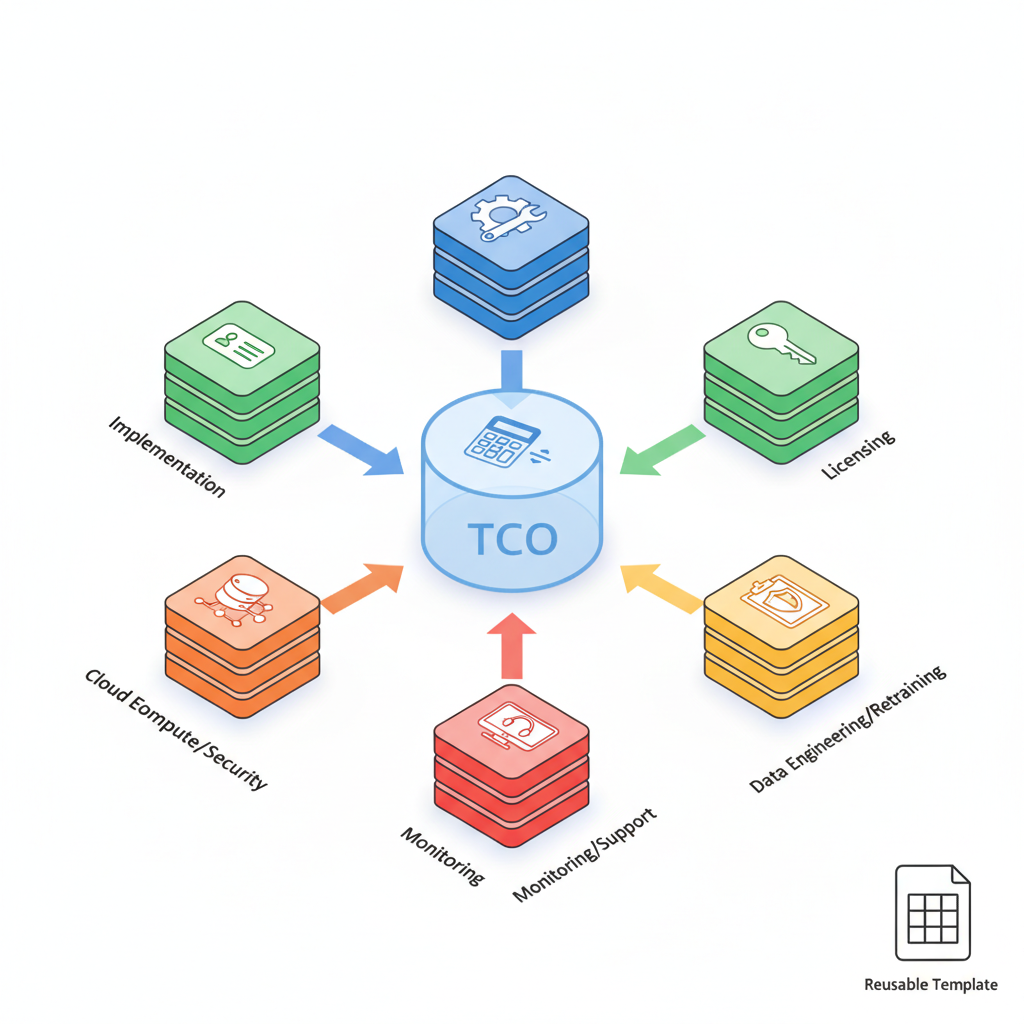
Quotable definition: "TCO for AI process automation = all one‑time implementation costs + recurring operational costs over the evaluation period (typically 12–36 months)."
This definition is intentionally short and extractable for snippet use. In practice, AI process automation TCO needs clear buckets (implementation, licensing, cloud, data & monitoring, governance) and regional adjustments — US labor and cloud prices often exceed APAC by a noticeable margin, while EU projects may add compliance overhead. To accurately assess costs, consider how to evaluate AI tool pricing using vendor-specific region pricing (AWS/GCP/Azure) when estimating cloud compute.
The components of TCO (one-time vs ongoing costs)
Break TCO into two clear groups so stakeholders understand where savings occur and where spend persists. One-time costs include discovery, solution design, proof of concept, and integration development. Ongoing costs include licenses, cloud compute, storage, network, monitoring, retraining, and support. Label each cost as either capitalized or operational to match accounting expectations.
Example: for a document-extraction automation, implementation costs ai process automation might include 120 developer hours for extractor integration and 40 hours of vendor setup; ongoing costs include an OCR/LLM subscription, cloud inference hours, and periodic retraining. When assembling a total cost of ownership ai automation estimate, present a 12-, 24-, and 36-month view so decision-makers see the trajectory.
Include both technical and human costs in the same spreadsheet; hidden headcount is where many projects derail.

Implementation and integration costs
Implementation costs capture the work to go from concept to production. That includes discovery, data mapping, API integration, workflow automation, testing, and initial model fine-tuning. For most teams this is the largest one-time spend because integrations touch legacy systems, authentication, and edge cases that don't appear in demos.
Actionable example: list every touched system (CRM, billing, CMS), estimate integration hours per system (e.g., 40–120 hours depending on complexity), and multiply by your blended developer rate. Don't forget QA, user acceptance testing, and a small buffer for vendor coordination. These numbers feed the implementation costs ai process automation line in your ai automation cost model.
Licensing and subscription fees
Licensing covers platform subscriptions, per-seat charges, and model access fees. Many vendors charge a fixed subscription plus usage-based fees for API calls or tokens. License maintenance costs ai tools typically appear as annual renewal fees and support tiers; factor in escalation to enterprise plans as usage grows.
Practical tip: request a pricing schedule that separates fixed seat/license fees from usage fees. In your spreadsheet, split licensing into fixed monthly fees and variable usage fees so you can model growth. For comparison, show pilot vs scale license scenarios to capture potential tier jumps.
Cloud compute, storage, and network costs
Cloud is the spend category with the most variability. Inference on large models, batch processing, and storage of training data all add up. Use the cloud provider's regional price lists (AWS, Google Cloud, Azure) rather than global averages: pricing differs by region and by instance type. If you use managed model APIs, map their per-token / per-request rates to expected monthly usage.
Concrete threshold: for interactive features, aim for P95 latency under 300ms; for batch jobs, estimate peak concurrent workers and provision accordingly. Model inference time multiplied by concurrent requests gives compute hours; multiply compute hours by instance price in your region to estimate cloud cost. Document these assumptions in the TCO worksheet.
Data engineering, monitoring, and retraining costs
Data work is ongoing. Expect costs for data pipelines, labeling, feature stores, observability, and retraining cycles. Monitoring must cover performance, bias, and data drift; without it, models silently degrade and you pay in errors and rework.
Example entry in your ai automation cost model: one data engineer (0.5 FTE) for pipeline maintenance, one ML engineer for retraining workflows (0.2 FTE), plus labeling costs per 1,000 samples. Schedule retraining cadence (monthly/quarterly) based on data drift risk and include the compute cost per retrain in recurring spend.
Support, governance, and overhead (security, compliance)
Support and governance are often underestimated. Add security reviews, penetration testing, privacy impact assessments, legal review, and incident response to the TCO. In regulated regions, compliance work can be a measurable recurring cost. License maintenance costs ai tools often include a support SLAs premium; quantify SLA tiers versus your risk tolerance.
Example: plan for a quarterly compliance review and annual penetration test. Assign an owner for governance and budget their time (hours per month) as overhead. Factor in the cost of audit evidence collection and any third-party attestations you require.
Step-by-step TCO template you can reuse
Build a simple spreadsheet with these sheets: assumptions, one-time costs, recurring costs (monthly), scenario dashboard, and sensitivity analysis. Use named rows for each cost bucket so formulas stay readable. The template below gives the structure to copy into your system.
- Assumptions: evaluation period (12/24/36 months), discount rate, region, team rates.
- One-time: discovery, integrations, testing, migrations.
- Recurring: licenses, cloud, data operations, support, retraining.
- Outputs: total TCO by period, monthly burn, cost per transaction.
Model both fixed and variable cost lines separately; variable lines reveal scale sensitivity.
Inputs to gather (usage volume, transactions, user seats, model complexity)
Gather measurable inputs before you estimate: expected monthly transactions, average tokens per transaction, concurrent users, number of user seats, model size/complexity (small embedding model vs large LLM), and data retention needs. These drive both cloud and licensing lines.
For example, if you expect 100,000 transactions/month and 200 tokens per transaction, compute the token volume and map that to per-token pricing. If you have 10 admin seats and 100 end-user seats, model fixed seat licenses separately from API usage. Record each input in the assumptions sheet so you can run sensitivity scenarios.
Example spreadsheet: 3 scenarios (pilot, scale, enterprise)
Create three columns in your scenario sheet and vary only the key drivers: transactions, seats, and SLA/support tier. Below is a compact example table you can copy into your spreadsheet and expand.
| Line item | Pilot (mth) | Scale (mth) | Enterprise (mth) |
|---|---|---|---|
| Transactions/month | 5,000 | 50,000 | 500,000 |
| License (fixed) | $500 | $2,000 | $10,000 |
| Cloud (variable) | $200 | $2,500 | $30,000 |
| Support & governance | $300 | $1,000 | $5,000 |
| Monthly total | $1,000 | $5,500 | $45,000 |
Calculating payback period and NPV for AI automation
To evaluate investment, compute payback (months until cumulative benefits exceed cumulative costs) and net present value (NPV) over your chosen horizon. Benefits include labor savings, error reduction, faster throughput, and revenue uplifts attributable to automation. Be conservative: only count benefits you can measure or reliably attribute.
Worked example: if automation saves two full-time equivalents at $80k/year (benefit $160k) and your 24-month TCO is $120k, the payback is under 12 months and NPV at a modest discount rate is positive. Run sensitivity: what if savings are 50% of expected? Model that too.
Common mistakes and blind spots when estimating TCO
Teams commonly miss hidden recurring work: monitoring, false-positive handling, edge-case remediation, and vendor support escalations. Another blind spot is assuming pilot pricing scales linearly — licensing tiers often jump, and cloud discounts may require committed spend.
Also avoid optimism bias on data readiness; unclean data multiplies engineering hours. Build a contingency line (10–25%) and track assumptions against reality during the pilot to reduce surprises.
When NOT to productionize AI process automation
- If you cannot measure outputs or define an acceptance metric, do not productionize.
- If data changes faster than you can retrain (high volatility) and you lack monitoring, pause production plans.
- If costs exceed clear user or operational value after a 24-month projection, delay scale-up.
Practical checklist: questions to ask vendors when building TCO
Use this vendor checklist during procurement to avoid surprises. Ask for regional pricing, detailed chargeback examples, support SLAs, and historical onboarding timelines. Request a sample invoice and a break-even analysis from the vendor using your inputs.
- Does the quote separate fixed license fees from usage charges?
- What are license maintenance costs ai tools and how do they escalate?
- Which region will compute run in and what are the exact instance prices?
- What monitoring and observability are included versus billed separately?
- Can you provide a runbook for incident escalation and cost for premium support?
Short case study: TCO calculation for an invoice-processing automation
Imagine a mid-size website operator automating invoice processing. One-time integration and mapping took 160 hours; recurring costs were an OCR/LLM subscription plus cloud inference. The team modeled 12/24/36 month scenarios and found that while the 12-month view showed a modest net benefit, the 24-month view included retraining and auditor costs and made the investment clearly positive.
Key lesson: include audit and compliance costs up-front. For a site like xproductlist.com that catalogs tools, documenting these cost lines makes vendor comparisons apples-to-apples and reveals where a higher license saves cloud spend or vice versa.
Actionable next steps and downloadable TCO template
Next steps: 1) gather the inputs listed in the template assumptions sheet; 2) ask vendors for regional pricing and sample invoices; 3) run the three scenario worksheet; 4) compute payback and NPV. These steps deliver a defensible, auditable total cost of ownership ai automation estimate you can present to finance.
Downloadable template: copy the checklist and table above into a spreadsheet to start. Use the scenario table as the decision artifacts to share with stakeholders.
FAQ
What does it mean to calculate total cost of ownership (tco) for ai process automation? Calculating ai process automation tco means summing all one-time implementation costs and all recurring operational costs over an evaluation period (typically 12–36 months) to produce a single comparable .
How do you calculate total cost of ownership (tco) for ai process automation? Calculate TCO by listing one-time implementation costs, adding recurring license, cloud, data, monitoring, and governance costs, projecting them across your chosen horizon, and then computing payback and NPV using conservative benefit estimates.